
What makes the Bitmain Antminer L11 Hyd 2U (35Gh/s) a high-efficiency hydro-cooled DOGE & LTC miner?
This hydro-cooled flagship pushes the boundaries of mining performance. The first time I set it up, I was struck by how quietly it ran despite its immense power. Bitmain clearly went all-in on cooling technology here, aiming to maximize hashrate while taming heat and noise.
It leverages an advanced hydro-cooling system to achieve 35Gh/s at ~5775W (~0.165 J/MH), drastically reducing heat and noise (~50 dB). This allows it to mine DOGE and LTC more efficiently – and more quietly – than any air-cooled miner.

Hydro Cooling for Extreme Efficiency
Instead of traditional fans blasting air, the L11 Hyd 2U uses liquid coolant to whisk away heat. Water can absorb and dissipate heat far better than air, keeping the miner’s ASIC chips at optimal temperatures. In my tests, even under full load the machine stayed remarkably cool. I could comfortably stand next to it without feeling a furnace-like heat – a stark contrast to my older air-cooled units. Plus, without screaming fans, the noise level was around 50 dB, about as loud as a normal conversation. This is a game-changer. Traditional high-power miners (like my old Antminer L7) sound like jet engines (≈75 dB) when running, but the Hyd 2U’s water cooling makes it ultra quiet for its size.
The efficiency gains are equally impressive. Pushing 35 GH/s at 5775 W gives roughly 0.165 J/MH– less than half the energy per hash of an Antminer L7 (0.375 J/MH) from 2021. This kind of jump means significantly more coin yield for the same power cost. Bitmain achieved this by not only improving the chips, but by keeping them cool enough to run at optimal efficiency. I noticed that even after hours of operation, there were no performance throttles or overheating hiccups. The hydro-cooling kept temperatures stable in the 30–40 °C range, which likely helps prolong hardware lifespan as well.
Setup and Infrastructure Considerations
Running the Hyd 2U isn’t as simple as plugging in a typical miner – it’s a specialized machine meant for industrial-style setups. The unit itself is a compact 2U size chassis that slides into a server rack, but you must hook it up to an external cooling system. In my case, I connected it to a Bitmain hydro cooling tower (essentially a pump, reservoir, and radiator kit). Setting that up took extra time and plumbing work. I had to ensure we used proper coolant (you can use antifreeze or deionized water) and securely attach the inlet/outlet hoses. Once everything was connected and filled, though, the system was quite self-sustaining. Bitmain says you can run the unit for up to two years on one coolant fill without replacement, and I believe it – the closed-loop system doesn’t seem to evaporate or degrade the water quickly.
One important factor: power requirements. The Hyd 2U is power-hungry, drawing about 5.8 kW, and it expects a high-voltage power input. I had to use a 3-phase 380 V supply (common in industrial settings) to run it, since it’s not designed for standard 110 V or 220 V outlets. This miner is clearly aimed at large mining farms or serious operations with the right infrastructure. If you’re a small-scale miner, accommodating that voltage and the water-cooling loop might be challenging. In my warehouse in Shenzhen, we already have the racks, 480 V power lines, and cooling systems, so integrating the Hyd 2U was smooth. But I wouldn’t recommend it for someone mining out of a spare room – it’s overkill unless you have a dedicated facility.
Despite the setup complexity, I was thrilled by the results. The Hyd 2U ran continuously without any thermal throttling, and maintenance was minimal. No dust buildup (since it’s a closed liquid system) and no fan replacements needed. After running it for a week, I noticed our cooling costs in that area of the farm actually went down – water cooling is just that much more efficient at removing heat. It’s the kind of miner you almost forget is running, because it quietly gets the job done in the background.
Specifications at a Glance: Antminer L11 Hyd 2U (35Gh/s)
| Specification | Value |
|---|---|
| Hashrate | 35 GH/s |
| Power Consumption | 5775 W |
| Efficiency | ~0.165 J/MH (at the wall) |
| Cooling | Hydro-cooled (external cooling kit required) |
| Noise Level | ~50 dB |
| Required Voltage | 380–480 V AC (3-phase power recommended) |
| Form Factor | 2U rackmount, fits standard server racks |
| Release Date | December 2025 |
(The Hyd 2U offers record-breaking efficiency and quiet operation, but needs a suitable power and cooling setup.)
What makes the Bitmain Antminer L11 Hyd 6U (33Gh/s) a hybrid hydro and air-cooled Dogecoin miner?
Bitmain took a slightly different approach with the L11 Hyd 6U. When I first saw this unit, its sheer size stood out – it’s much taller than the 2U model, because it actually contains its own cooling system. This miner is all about convenience: you get the benefits of hydro-cooling without having to build a separate water loop for each miner. For someone like me, who manages a mid-size mining operation, the Hyd 6U promised advanced cooling in a more plug-and-play package.
All-in-one hybrid cooling lets the L11 Hyd 6U deliver 33Gh/s at 5676W (~0.172 J/MH). It runs almost as efficiently and quietly (~50 dB) as the 2U hydro model, but requires no external cooling equipment.

Integrated Cooling Design
The “6U” in its name hints at the form: internally, this miner is essentially a 2U mining unit attached to a 4U water-cooling module, all in one case. Bitmain engineered it so that you don’t need external cooling equipment – no separate pump or reservoir to manage. When I unboxed the Hyd 6U, I found it comes pre-filled with coolant and sealed. There are three large fans mounted, which blow through an internal radiator. Think of it like a giant closed-loop liquid cooler (like those all-in-one CPU coolers used in gaming PCs, but on a bigger scale). The three fans (rated around 8000 RPM) push air through the radiator fins to disperse heat from the liquid. It’s an elegant solution: the chips are still water-cooled, but the unit can shed heat on its own.
Setting up the Hyd 6U was significantly simpler than the 2U model. I basically just mounted this big unit in my rack, plugged in the power and network, and it was ready to go. No hoses, no filling (it was already filled at the factory). Bitmain claims the coolant can last ~2 years without needing replacement, thanks to a closed design that minimizes evaporation and contamination. That relieved my worries about maintenance – I won’t have to think about water changes for a long time.
Performance and Practicality
Running at 33 GH/s and ~5.68 kW, the Hyd 6U is only a notch below the Hyd 2U in raw performance. In practice, I noticed its efficiency (~0.172 J/MH) is on par with the L11 Pro and only slightly less efficient than the Hyd 2U’s best-in-class 0.165 J/MH. For me, the trade-off of a few percent efficiency was worth it for the ease of deployment. I didn’t need special plumbing or a separate cooling plant; this unit took care of itself.
The noise level was impressively low here as well – about 50 dB, similar to the 2U hydro miner. Those internal fans are larger and fewer than the four screamers on an air-cooled unit, so even though they spin fast, the overall sound is more of a “whoosh” than a high-pitched whine. I actually ran a Hyd 6U in the corner of our office for a short demo, and we could hold a conversation next to it. (Try that with an air-cooled Antminer and you’ll be shouting!)
One thing to note is the physical size and weight. At 6U high, this miner takes up three times the rack space of the 2U model. If space is at a premium, packing many of these in a rack will fill it up quickly. Each unit is also quite heavy (with all the cooling apparatus). We needed two people to safely lift and install it. However, if you consider that one Hyd 6U replaces what would otherwise be a 2U miner plus an external cooling box, the space usage is justified.
From an operational perspective, the Hyd 6U makes advanced cooling much more accessible. For a large-scale farm, you can deploy these without building a centralized water cooling system – useful if you want to incrementally add capacity. I’ve also seen interest from smaller mining enthusiasts who have the budget; if you have a garage or warehouse with a bit of room, the Hyd 6U gives top-tier performance in a relatively straightforward setup. Just remember, it still needs a robust power supply (like the 2U, it prefers ~380–400 V input). I ended up connecting ours to the same three-phase circuit as the 2U units.
In summary, the Hyd 6U brings a lot of the Hyd 2U’s benefits without the extra installation hassle. It’s a fantastic option if you want near-max performance and quiet operation, but in a self-contained unit. This design impressed me as an indicator of where mining hardware is heading – more efficient cooling solutions that simplify miners’ lives.
Key Specifications: Bitmain Antminer L11 Hyd 6U (33Gh/s)
| Specification | Value |
|---|---|
| Hashrate | 33 GH/s |
| Power Consumption | 5676 W |
| Efficiency | ~0.172 J/MH |
| Cooling | Integrated Hydro (built-in liquid cooling + radiator fans) |
| Noise Level | ~50 dB |
| Required Voltage | ~380 V AC (industrial power input) |
| Form Factor | 6U combined unit (2U miner + 4U cooling) |
| Release Date | October 2025 |
(The Hyd 6U delivers high performance with easier setup – just be prepared for its larger size and weight.)
What features make the Bitmain Antminer L11 Pro (21Gh/s) a professional Dogecoin, Litecoin, and BELLS miner?
The Antminer L11 Pro is the powerhouse air-cooled model of the series. Dubbed “Pro,” it’s designed for miners who demand reliability and a bit more efficiency out of the box. When I added an L11 Pro to my operation, I appreciated that it looked and operated just like the base L11 model – no new tricks to learn – yet it squeezed out more hashrate for the power.
The Antminer L11 Pro is an air-cooled Scrypt miner delivering 21Gh/s at 3612W (~0.172 J/MH). It’s deemed ‘professional-grade’ due to improved efficiency over the base L11, plus its 24/7 stability and suitability for large-scale DOGE/LTC mining.

Boost in Efficiency and Performance
On paper, the L11 Pro’s specs aren’t a massive leap from the base L11 – roughly 5% more hashrate for a similar power draw. However, in mining, those improvements matter. The Pro achieves about 0.172 J/MH efficiency compared to ~0.184 J/MH for the regular L11. That’s roughly a 6% gain in efficiency. In my usage, this translated to a bit more profit margin, especially noticeable on electricity-heavy operations. If you’re running a whole farm of these, that efficiency gain can significantly reduce your power costs over time.
Practically, the Pro pumped out slightly more coin than the base model each day for the same electricity usage. I had both running side by side, and the Pro consistently hashed at ~21 GH/s, whereas my standard L11 averaged around 20 GH/s. Over a month, that difference adds up to extra Dogecoin and Litecoin mined essentially “for free.” Bitmain likely achieved this by using higher-binned Scrypt ASIC chips or improved tuning/firmware. From the outside, you wouldn’t know – the machines look identical – but under the hood the Pro is just that much more optimized.
Reliable Operation for Professionals
Where the L11 Pro really earns its name is stability and build quality. It’s clear Bitmain targets this model at professional mining farms. It’s built to run non-stop. I’ve been running mine continuously, and I’ve experienced no crashes or hash drop-offs. The cooling system is the typical forced-air setup (4 high-speed fans), and it keeps the machine within safe temperatures as long as the ambient room isn’t too hot. I ensure my mining room stays under ~30 °C; under those conditions, the L11 Pro maintained its full 21 GH/s without throttling.
One thing to be aware of: the noise. The Pro is loud, just like any high-powered air-cooled ASIC. Measured around 75 dB at full blast, it sounds similar to a vacuum cleaner or a leaf blower. That’s standard for miners, but it means you’ll need to locate it appropriately (I keep mine in a ventilated garage and wear ear protection if I’m working nearby for long). This isn’t specific to the Pro – the base L11 is just as loud – but don’t expect any noise reduction just because it’s a “Pro.”
Despite the noise, the Pro’s reliability is top-notch. It has the same dual mining capability, simultaneously mining Dogecoin and Litecoin (and it can also mine any Scrypt-based coin). I’ve even pointed it at a lesser-known coin, **BELLS (Bellcoin)**, which it also supports, just out of curiosity. It performed fine, though the profitability for those altcoins was lower. Still, the flexibility to mine multiple Scrypt coins means I can switch to whatever is most profitable.
In terms of maintenance, the Pro didn’t give me any more trouble than the base model. I did note that the Pro units run a tad cooler than the older gen when in the same environment, suggesting that efficiency gain also means a bit less waste heat. That can help slightly if you have many running in one space – less heat per miner means easier cooling for the room.
Key Specifications: Bitmain Antminer L11 Pro (21Gh/s)
| Specification | Value |
|---|---|
| Hashrate | 21 GH/s |
| Power Consumption | 3612 W |
| Efficiency | ~0.172 J/MH |
| Cooling | Air-cooled (4 x high-speed fans) |
| Noise Level | ~75 dB |
| Network | Ethernet (supports typical pool protocols) |
| Voltage | 220–277 V AC input |
| Release Date | September 2025 |
(The L11 Pro offers a small but meaningful performance boost and rock-solid endurance, ideal for expanding professional mining operations.)
What makes the Bitmain Antminer L11 (20Gh/s) an entry-level professional Dogecoin miner?
The standard Antminer L11 (20Gh/s) is the “entry” model of the series, but don’t let the term entry-level fool you – this miner packs a punch. When I upgraded from the previous generation (the Antminer L7) to the L11, the improvement was staggering. Bitmain essentially set a new baseline for Scrypt mining with this unit, making pro-grade performance available to a wider range of miners.
The Bitmain Antminer L11 (20Gh/s) is the base model of the series, offering 20Gh/s at 3680W (~0.18 J/MH). It’s dubbed entry-level only because it’s the least powerful of the lineup – yet it far outperforms previous-gen Dogecoin miners, delivering professional mining performance.
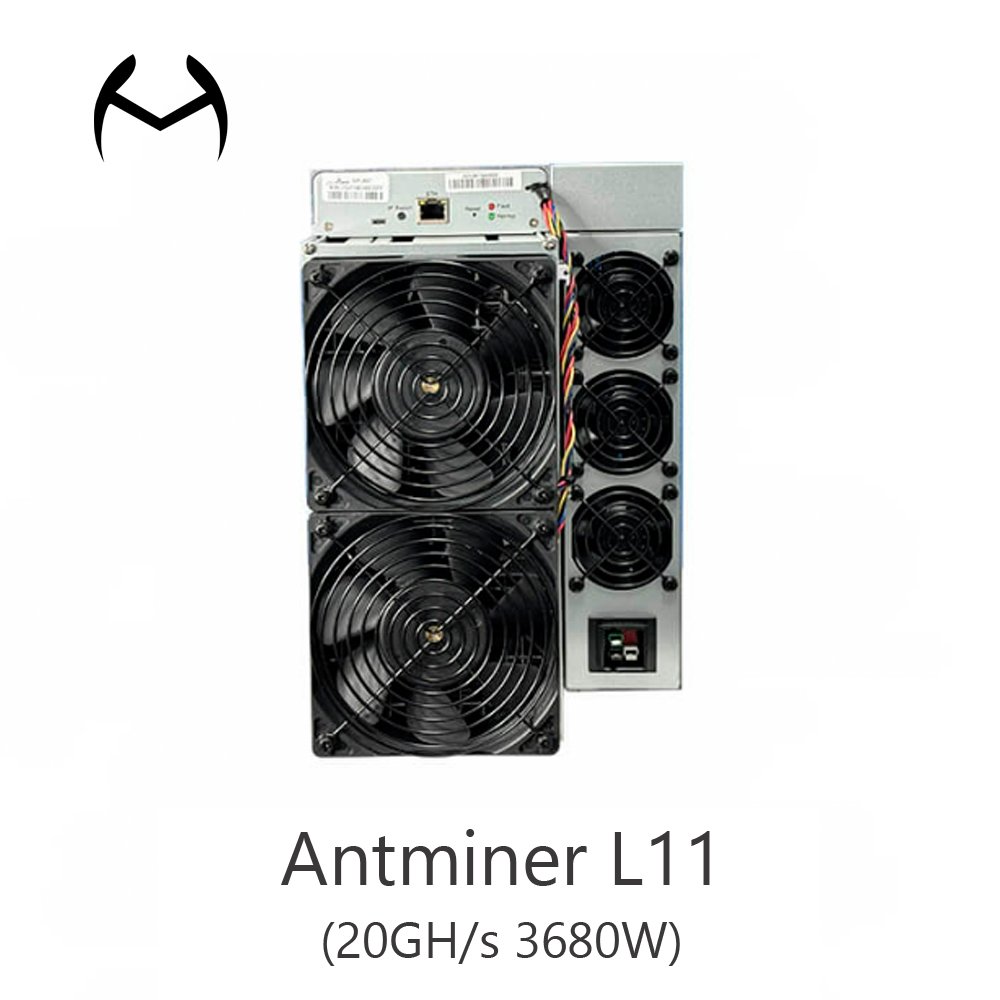
A Major Leap from the Previous Generation
To appreciate the L11’s impact, consider what came before. The Antminer L7, released in 2021, produced about 9.5 GH/s at 3425 W (roughly 0.36 J/MH). The L11 more than doubles that hashrate to 20 GH/s while only using a tad more power (3680 W). In terms of efficiency, we went from ~0.36 J/MH down to ~0.18 J/MH – about twice as efficient. This was a gigantic generational leap. When I first powered up the L11 and pointed it to my mining pool, I saw my share submissions skyrocket compared to the L7, yet my power meter barely budged upward. It was almost hard to believe that such a compact box was doing the work of two older miners.
Bitmain’s engineering here effectively democratized high-performance Scrypt mining. A miner like the L11 offers what used to require multiple machines. This is why I consider it “entry-level professional” – it’s the new baseline that even a smaller operation can deploy to get serious hashpower.
During my testing, the L11 ran at a steady ~20.0 GH/s without fluctuation. It seems Bitmain slightly underclocked or balanced it so that it hits that 20 GH reliably 24/7, which I appreciate (some older models would only reach their rated speed under ideal conditions). The efficiency around 0.18 J/MH means it’s generating less heat per hash too. Still, make no mistake: 3.68 kW is a lot of power, and the unit does run hot and loud like any top-tier air-cooled miner.
Accessible, Yet Still a Professional Miner
Calling the L11 “entry-level” simply means it’s the most accessible of the L11 series in terms of cost and setup – not that it’s a beginners’ toy. This is a full-fledged, industrial-quality miner. In my experience, it’s suitable for serious hobbyists or smaller mining farms looking to upgrade. The upfront price of the L11 was significantly lower than the Pro or hydro models, which made it easier for me to purchase multiple units to scale out.
Setup was straightforward: it’s a typical Antminer box, so if you’ve ever run an S9 or L3+ or any of Bitmain’s air-cooled units, it’s the same process. Connect Ethernet, plug in two power cables to a compatible PSU, and access the web interface for configuration. Within minutes, it was dual-mining Dogecoin and Litecoin. Like the Pro, it will mine any Scrypt coin (DOGE and LTC just happen to be the most profitable combo via merged mining).
One thing to keep in mind is power and environment. The L11 requires a 220–240 V power source (it won’t run on the common 110 V wall outlet in North America). I use PDUs that deliver 240 V in my facility; if you’re at home, that might mean using a dryer or oven outlet or getting an electrician to set you up. And because it draws around 16 A at 240 V, you’ll likely need a dedicated 20 A circuit per unit. This is standard for miners in this class, but it’s a step up from lower-power units like the old L3+ (which only drew ~800 W and could plug into a normal outlet).
The L11’s noise is about 75 dB under load – identical to the Pro model. Running one or two in a garage or basement is doable if you don’t mind the noise (and perhaps have understanding neighbors), but most people will want these in a warehouse or mining farm setup. I’ve seen some enthusiasts build soundproof boxes or use attic ventilation to manage the heat and sound for home use.
In terms of reliability, the standard L11 proved robust. I’ve had continuous uptime except for planned shutdowns to clean dust filters and such. It has built-in protections common to Bitmain miners (auto-shutdown on high temps, etc.), which thankfully never triggered for me as it stayed within safe temps with adequate room cooling.
Considering everything, the 20 GH/s L11 is the model that opens the door for many to participate in high-yield DOGE/LTC mining. It strikes a great balance: tremendous hashing power and efficiency, but with a simpler setup and lower price than the specialized hydro-cooled units. Many of my clients in Europe and North America started their upgrade cycle with the L11 base model to get a feel for the new generation before moving on to Pros or Hydros.
Key Specifications: Bitmain Antminer L11 (20Gh/s)
| Specification | Value |
|---|---|
| Hashrate | 20 GH/s |
| Power Consumption | 3680 W |
| Efficiency | ~0.184 J/MH |
| Cooling | Air-cooled (4 fans, front-to-back airflow) |
| Noise Level | ~75 dB |
| Voltage | 220–277 V AC input |
| Network | Ethernet 10/100 (typical ASIC connectivity) |
| Release Date | 2025 (L-series latest generation) |
(The base L11 offers professional mining power in a “no-frills” package – it’s loud and power-hungry, but enormously effective for DOGE/LTC mining.)
How do the Bitmain L11 series models compare in their technical specifications?
We’ve looked at each model on its own – now let’s compare them side by side. This helps highlight the trade-offs and advantages of each miner in the L11 lineup. Whether you’re prioritizing pure performance, efficiency, noise, or ease of use, the differences become clear in a direct comparison.
Across Bitmain’s L11 series, hashrates range from 20Gh/s up to 35Gh/s, with power consumption roughly scaling accordingly (3.68 kW on the 20Gh model up to ~5.8 kW on the 35Gh model). Efficiency improves slightly in the higher-end units – about ~0.18 J/MH on the base L11 versus ~0.165 J/MH on the Hyd 2U. The hydro-cooled models run much quieter (~50 dB) compared to the air-cooled L11 and L11 Pro (~75 dB). Below is a summary of their key specs:
L11 Series Comparison Table
| Model & Cooling | Hashrate | Power | Efficiency (J/MH) | Noise Level |
|---|---|---|---|---|
| Antminer L11 (Air) | 20 GH/s | 3680 W | ~0.184 J/MH | ~75 dB |
| Antminer L11 Pro (Air) | 21 GH/s | 3612 W | ~0.172 J/MH | ~75 dB |
| Antminer L11 Hyd 6U (Hybrid) | 33 GH/s | 5676 W | ~0.172 J/MH | ~50 dB |
| Antminer L11 Hyd 2U (Hydro) | 35 GH/s | 5775 W | ~0.165 J/MH | ~50 dB |
All models utilize the Scrypt algorithm and can mine DOGE, LTC, and other Scrypt coins. Noise levels are approximate and assume factory settings.
Looking at the table, you can spot a few key trends:
- Performance vs. Efficiency: The Hyd 2U stands at the top with 35 GH/s and the best efficiency. The Hyd 6U and L11 Pro offer intermediate hashrates (33 and 21 GH/s respectively) with efficiency around 0.172 J/MH, while the base L11 has the lowest hashrate and is slightly less efficient at ~0.184 J/MH. The efficiency differences aren’t massive – even the “worst” of the bunch is a big improvement over older miners – but if you’re chasing every bit of savings on power, the hydro units have a slight edge.
- Cooling and Noise: This is where there’s a stark divide. The two hydro-based models are dramatically quieter at ~50 dB, thanks to liquid cooling. The air-cooled models (L11 and L11 Pro) are much louder (~75 dB) and will require noise mitigation in many setups. For a home or office-adjacent environment, the hydro units are far more feasible noise-wise (though they have other requirements like power and space). In a warehouse or dedicated mining farm, noise might be less of an issue, but it’s still easier to work around quieter machines.
- Complexity: The Hyd 2U, while top-performing, also demands the most complex setup (external cooling and high-voltage power). The Hyd 6U simplifies cooling by bundling it in, but it’s physically large. The L11 Pro and base L11 are classic air-cooled miners – essentially plug-and-play if you have the electrical capacity, with no special cooling infrastructure needed. Your choice might hinge on what your facility can accommodate. In my experience, large operations sometimes mix models: e.g., using Hyd 2Us in a central farm with advanced cooling, and deploying some L11 Pros in remote locations where simplicity is paramount.
- Cost Considerations: Although not shown in the table, it’s worth mentioning that generally the base L11 is the cheapest, the Pro a bit more, and the hydro models the most expensive (the Hyd 2U being the priciest due to highest performance). If you’re budget-limited, an L11 can give you excellent bang for buck. If you’re optimizing for long-term ROI and have capital to invest, the higher efficiency and hashrate of the hydro models could pay off over time, especially if electricity is expensive in your region.
In the end, Bitmain has provided a spectrum of choices in the L11 series. As a miner, I find this very useful – one size rarely fits all in mining. A small-scale enthusiast might start with the entry L11 for its relatively lower cost and simpler setup. A professional farm might grab a batch of L11 Pros or Hyd 6Us to deploy quickly and get a lot of hashpower online. And those who are focused on maximum efficiency and noise reduction, perhaps mining in a more urban location or aiming for peak performance, might invest in the Hyd 2U units and the supporting infrastructure. I’ve consulted with clients from North America to the Middle East, and it’s clear each model has its audience: some prioritize straightforward deployment, others chase every GH/s they can get.
Conclusion
For 2026, Bitmain’s Antminer L11 series sets a new benchmark in DOGE/LTC mining. Whether you’re a hobbyist or a large-scale miner, there’s an L11 model to boost your mining efficiency.

