
Is Bitcoin mining or AI computing more profitable in 2025?
The allure of profit is what drew many miner into Bitcoin mining years ago. Now we see a new gold rush in AI computing, and miner need to know which yields more value today.
In 2025, AI workloads tend to be more profitable than Bitcoin mining. One report found that renting data center capacity to AI can bring in around $0.25–$0.35 per kWh, whereas Bitcoin mining earns only about $0.07–$0.09 for the same energy. That translates to roughly 3–4 times more revenue per unit of electricity by serving AI needs instead of mining BTC.

The Post-Halving Squeeze on Mining Profits
Bitcoin’s built-in cycles have made mining tougher lately. After the 2024 “halving,” the reward for mining new bitcoins dropped from 6.25 BTC to 3.125 BTC per block. I felt this squeeze firsthand – suddenly, my mining rigs were earning half the coins for the same work. Unless Bitcoin’s price soars enough to compensate, a halving slashes a miner’s revenue overnight. In 2025, Bitcoin’s price did rise (even above $100k briefly) but competition and higher electricity costs ate into margins. Many public mining companies saw their profits dip and started exploring other income streams. I watched industry peers take out loans and issue stock to stay afloat, raising over $4.6 billion in late 2024 and early 2025 to fund new projects beyond traditional mining.
AI Demand: A Lucrative New Frontier
On the other hand, the demand for AI computation has exploded. Running large AI models (for things like chatbots or image generators) requires enormous computing power and companies are willing to pay top dollar for it. I learned that some Bitcoin mining firms pivoting to AI have achieved striking results. For example, one miner (IREN) reported hardware profit margins around 97% after offering AI cloud services, even as pure Bitcoin mining profits fell by 7% during the same period. The financial incentive is clear. A single megawatt of power dedicated to Bitcoin mining might yield around $70–$90 in revenue per hour. That same megawatt used for AI tasks can earn roughly $250–$350. This huge gap in revenue per kWh means higher **EBITDA** (earnings before interest, taxes, depreciation, and amortization) margins too – roughly 55–65% in classic mining versus an estimated 70–80% when hosting AI computing.
To put it simply, I can make a lot more money running an AI data center than a Bitcoin mine with the same electricity. It’s no wonder that miners’ stock prices jumped in late 2025 when companies announced AI initiatives. CleanSpark, a large mining firm, saw its shares pop 13% in one day after unveiling plans to build AI data centers alongside its Bitcoin operations. Investors are excited because AI services often bring in steady, long-term contracts, unlike the rollercoaster of crypto prices. As a business owner, I find the prospect of more stable cash flow very appealing – it means not being entirely at the mercy of Bitcoin’s volatility.
| Profitability Factors (2025) | Bitcoin Mining | AI Data Center |
|---|---|---|
| Revenue per kWh of power | ~$0.07–$0.09 | ~$0.25–$0.35 |
| EBITDA Margins | ~55–65% | ~70–80% |
| Recent Trend (2025) | Block rewards halved; profit margins shrinking | Surging demand; 25%+ annual market growth |
| Investor Sentiment | Cautious (volatile returns) | Optimistic (steady leases, high valuations) |
Still, profitability isn’t everything. Bitcoin mining’s value proposition goes beyond short-term revenue. I remind myself that Bitcoin serves a unique financial purpose – it’s like digital gold and supports a decentralized network for millions of users. Some argue this utility justifies the costs. Additionally, mining hardware (ASICs) has few other uses, so miners can’t easily switch tasks if crypto prices dip. By contrast, AI hardware (GPUs) can be rented out for various applications, providing more flexibility. For me, the calculation also involves long-term belief in Bitcoin. If I expect BTC’s price to skyrocket, mining could pay off handsomely despite the current headwinds.
In summary, as of 2025, AI looks financially “better” on paper for each watt of power I manage. That’s why we see a wave of miners diversifying into AI. But higher profit comes with its own challenges – including steep upfront costs for AI hardware and new technical expertise, which I’ll explore next. And profitability alone doesn’t answer which path is more sustainable or aligned with my goals, so let’s look at the energy and environmental angle too.
Which has a bigger environmental footprint: Bitcoin mining or AI computing?
Running thousands of machines 24/7 draws an immense amount of electricity. I care about where that power comes from and what it means for the planet. There’s a heated debate over whether Bitcoin mining or AI is a bigger culprit when it comes to energy use and carbon emissions.
Bitcoin mining currently consumes roughly 120 terawatt-hours (TWh) of electricity per year – about as much as the entire country of Argentina. AI’s energy footprint is racing upward and could rival or even exceed Bitcoin’s by the end of 2025. Both industries are under pressure to use cleaner energy sources to reduce their environmental impact.

Power Consumption: Bitcoin vs. AI
When I walk into my mining facility, the heat and noise make the energy usage tangible – you can feel the electricity being turned into computations (and heat). The Cambridge Centre for Alternative Finance estimates the Bitcoin network uses around 120 TWh annually as of mid-2025. This is a huge number – critics love to point out it’s on the order of a small country’s power consumption. But what about AI? Training and running AI models also devours electricity at scale, though these figures were less discussed until recently. According to a recent analysis, AI could use nearly half of all global data center power by the end of 2025 as companies deploy more servers for machine learning. Data centers worldwide already consume a few hundred terawatt-hours per year, so AI alone might be chewing through a Bitcoin-level chunk of power very soon. In 2024, one estimate put AI’s global data center usage around 80+ TWh and rising fast, meaning AI may overtake Bitcoin in energy draw as we head into 2025.
From my perspective, both technologies are energy-hungry beasts. The difference lies in perceived usefulness. Some people label Bitcoin’s energy use as “wasteful” since it’s largely spent on solving math puzzles to secure the blockchain. In contrast, they see AI computing as more productive because it’s performing tasks like language translation, scientific research, or business analytics. However, this view can be subjective. As someone in the crypto industry, I see Bitcoin providing a global financial service – millions of transactions and a store of value for people in countries with unstable currencies. That’s a significant output for the energy input. Meanwhile, AI’s energy consumption is starting to raise eyebrows as well. Big tech companies have begun revealing that their carbon footprints are growing due to AI operations – for instance, Google and Microsoft reported notable increases in emissions as they ramp up AI data centers. In other words, AI isn’t “clean” just because the work seems more directly useful; it can be quite carbon-intensive if powered by fossil fuels.
Going Green: Efforts and Criticisms
I strive to run a responsible business, so I’ve been investing in power-efficient miners and sourcing electricity from renewables where possible. Bitcoin miners, in general, are increasingly using renewable energy or otherwise wasted power (like excess hydroelectric or natural gas that would be flared). In fact, industry surveys indicate that about 50–60% of Bitcoin mining’s electricity comes from renewable sources today. My own operations in China tap into hydroelectric power during the wet season, which not only cuts costs but also lowers our carbon footprint. This is a counterpoint to the common idea that “Bitcoin is an environmental disaster.” The reality is nuanced: mining can actually incentivize the buildout of renewable infrastructure by providing a buyer for cheap excess energy that would otherwise go unused.
On the AI side, major players also claim a focus on sustainability – they buy renewable energy credits and invest in green data centers. Yet, I’ve noticed a trend where energy companies are planning new gas-fired plants just to supply AI data center growth. The surge in AI demand is so sudden that it’s straining power grids. In places like Texas, there are already waiting lists and delays for hooking up new high-capacity data centers (whether for crypto or AI) because the grid infrastructure needs to catch up. If both AI computing and crypto mining keep growing, they could compete for limited electricity in some regions, potentially driving up prices and even increasing reliance on fossil fuels if renewable development lags behind demand.
From an environmental standpoint, neither technology gets an outright gold star. Both need to manage their energy sources responsibly. Bitcoin’s protocol has a built-in mechanism (the halving) that indirectly caps its growth in energy use over time – as rewards shrink, only the most efficient miners survive, which can lead to older, less-efficient machines being retired. AI has no analogous cap; its energy appetite is limited only by how much computing we decide to throw at bigger and bigger models. This open-ended growth means AI’s power use could far surpass Bitcoin’s in a few years unless major efficiency gains or policy interventions occur.
Personally, I feel a responsibility to innovate on sustainability. In my mining warehouses, we’ve started experimenting with immersion cooling (submerging miners in liquid) to reuse heat and reduce cooling costs. Interestingly, some of these practices come from the data center world and now mining is adopting them – and vice versa. New AI data centers are learning from miners about securing cheap energy deals and even load balancing. For example, some mining operations pause or reduce their activity during peak grid demand times (helping local utilities), and AI centers can do something similar during crunch periods. I am convinced that whichever field – Bitcoin or AI – can demonstrate a cleaner energy mix will gain a public relations and possibly regulatory advantage. Both are under the microscope, so the greener they become, the better for everyone.
In short, Bitcoin and AI both consume massive power, but AI’s share is growing rapidly. The key question is not just who uses more, but how that energy is sourced. If you ask me which is “better” for the environment right now, I’d say it’s a tie in that both need improvement. The encouraging part is that both industries are pushing towards renewables and efficiency – out of both economic necessity and social pressure. This competition could spur innovations in clean energy that benefit us all.
| Category | Bitcoin Mining | AI Computing |
|---|---|---|
| Annual Energy Use (2025) | ~120 TWh/year (similar to Argentina) | ~80+ TWh in 2024; could reach Bitcoin-level or exceed it by end-2025 |
| Growth Trend | Relatively steady; energy growth slows as difficulty + halving force efficiency | Explosive growth; AI could consume nearly 50% of global data center power by late 2025 |
| Main Source of Energy Consumption | Proof-of-Work computations, 24/7 mining farms | Training + inference for large AI models; continuous server expansion |
| Carbon Emissions | Improving as renewable usage grows | Rising — Google & Microsoft report emissions increases due to AI expansion |
| Renewable Energy Usage | 50–60% estimated renewable share | Many claim renewable use, but expansion is driving new fossil-fuel plants in some regions |
| Environmental Criticism | “Wastes energy on math puzzles,” though miners argue it provides global financial utility | Considered “useful” energy, but scaling is causing emissions spikes and grid strain |
| Grid Impact | Often located near cheap/off-grid power; can curtail operations during peak demand | Rapid expansion causing grid delays; several regions planning extra gas plants |
| Efficiency Trend | Increases over time; halving forces retirement of inefficient miners | No built-in limit; energy use grows with model size and demand |
| Cooling & Sustainability Efforts | Immersion cooling, hydro season mining in China, use of stranded energy | Green data centers, renewable credits, but still high dependence on grid power |
| Industry Maturity | More stable, predictable energy use | Accelerating rapidly with no natural cap |
| Long-Term Risk | Criticism if renewables drop or fossil-fuel mining increases | Potentially much larger environmental footprint if model sizes keep scaling |
| Overall 2025 Impact | Large footprint, improving mix | Large and rapidly increasing footprint |
| Winner (Environmental Impact) | Tie — both need greener power sources | Tie — AI could become worse if growth continues unchecked |
How do Bitcoin mining and AI computing differ in hardware and infrastructure requirements?
Stepping into a Bitcoin mining farm versus an AI data center feels like visiting two different planets of technology. I have experience building mining facilities, but the first time I toured a cutting-edge AI computing center, I was struck by how distinct the equipment and setup were. Let’s break down what each requires.
Bitcoin mining relies on specialized hardware (ASIC miners) designed just for hashing, housed in relatively simple facilities, while AI computing uses general-purpose high-performance hardware (GPUs or TPUs) in ultra-dense data centers with advanced cooling and high-speed networking. In short, a mining farm is like a warehouse full of custom “money-making” machines, whereas an AI data center is more like a supercomputer hub built for complex computations.

Specialized ASICs vs. Versatile GPUs
All of my Bitcoin miners are ASICs – Application-Specific Integrated Circuits. These are machines built to do one thing extraordinarily well: perform the SHA-256 hashing algorithm to mine Bitcoin. They cannot run Windows, they cannot play video games, and they definitely cannot train an AI model. But their single-minded design means they are extremely efficient for mining, squeezing the most hashes out of every watt of power. For example, an Antminer S19 might perform 100 trillion hashes per second while consuming around 3,000 watts. In contrast, AI computing typically revolves around GPUs (Graphics Processing Units) or specialized AI chips like Google’s TPU. GPUs are the workhorses for training neural networks – they excel at the kind of matrix math behind AI tasks. A high-end NVIDIA GPU can draw 300 watts or more, and data centers pack dozens or hundreds of these into clusters to tackle AI workloads. These chips are general-purpose (you could mine certain cryptocurrencies with GPUs too, though not Bitcoin efficiently; Ethereum used to be mined on GPUs before it shifted away from mining). The big difference is flexibility: I can repurpose a GPU server farm to do many tasks (AI, rendering, scientific simulations), but I can only use an ASIC miner for Bitcoin (or potentially other coins on the same algorithm). This means the hardware investment for AI can adapt to demand shifts, while ASICs are a more narrow bet.
Facility and Cooling Demands
My mining farm in Shenzhen is essentially a large warehouse with heavy-duty fans and ventilation. The ASICs generate a lot of heat and noise, but we can manage with air cooling and exhaust systems. The power density is relatively low – a rack of ASIC miners might pull on the order of 20–30 kW. In contrast, when I visited an AI data center, I saw racks that draw well over 100 kW each, filled with GPU blades and connected by thick bundles of network cables. The cooling infrastructure was on another level: chilled water piping and even liquid-cooling for the hottest components. One modern AI cluster rack can require liquid-to-chip cooling because air alone can’t carry away the heat from so many densely packed, high-wattage processors. Mining farms rarely need that kind of cooling sophistication, since you can space out ASIC machines and use airflow. But high-performance AI gear demands a controlled environment – often clean, raised-floor data halls with strict temperature and humidity regulation. In short, a Bitcoin mine can look like a big industrial garage with rigs on shelves and giant fans on the walls, whereas an AI data center resembles a sterile labyrinth of black cabinets, chilled water units, and fiber optics.
Networking and Connectivity
Another stark difference I’ve dealt with is internet connectivity. Bitcoin miners don’t require much bandwidth at all. Each ASIC is basically just submitting small pieces of data (hash results) to a mining pool. My whole facility’s internet usage is minimal – it’s more important that the connection is stable than it is fast. AI centers, though, are a completely different story. When training AI models, especially across many servers, you need ultra-fast data exchange between machines. We’re talking about low-latency, high-bandwidth networks like InfiniBand or 100+ Gigabit Ethernet connecting servers in a cluster. Without these, the GPUs can’t effectively work in tandem on big problems. Additionally, AI data centers often need excellent external connectivity to send and receive large datasets from researchers or cloud users. Many Bitcoin mining farms are in remote areas near cheap power (like rural Texas or Sichuan, China) and can run fine on a basic broadband link. But if I were to host AI clients, I might need to lay fiber optic lines or partner with a telecom provider to ensure high-speed connectivity. In the CryptoMinerBros article I read, they noted that strategic mining sites have “dark fiber” access – already connected to major internet backbone – which is a big plus if converting into AI facilities.
Power Infrastructure and Scalability
One advantage I have as a miner is existing power infrastructure. My operations secured electrical grid connections and transformers capable of supporting tens of megawatts of load. Not every industry player can boast that. Building a new data center from scratch can take 2–4 years just to handle grid hookups and permits. By contrast, miners like me already negotiated those hurdles to get our mines running. We often have large substations built and land acquired, sometimes in places where it’s easy to expand. This is why many say Bitcoin miners hold an edge in pivoting to AI – we already control a lot of power at scale, sometimes hundreds of megawatts at a single site. Some large miners even have potential access to gigawatts of energy through future projects. For instance, having a warehouse with 100 MW of power lines in place means I could allocate some of that capacity to new AI servers rather quickly. In fact, existing mining facilities can be **retrofitted for AI hardware in as little as 4–6 months,** repurposing the power and cooling systems much faster than the 2+ years it usually takes to build a new site. This agility is a key reason I see collaboration rather than competition – miners can help meet AI demand faster by offering ready-made infrastructure.
However, making an old mining farm AI-ready isn’t as simple as plugging in some GPUs. There are real challenges. Traditional mining setups might lack the robust cooling and networking I mentioned, so they need upgrades. Also, GPUs are expensive and often scarce, so scaling up AI hardware means big capital outlays and dealing with supply chain issues (it’s not uncommon to wait months for large GPU orders). Running an AI operation also needs different expertise – software engineers, machine learning specialists, and new maintenance skills. In my case, I’d have to either hire new talent or partner with an AI firm to manage the servers, since maintaining a Bitcoin ASIC cluster is quite different from troubleshooting AI training jobs. The Sazmining blog highlighted that miners don’t yet have the know-how in things like ML workload management and specialized software stacks. We might be experts in keeping thousands of machines running and power flowing, but the AI realm has its own learning curve.
To summarize the infrastructure gap: Bitcoin mining is hardware-centric and power-centric in a straightforward way – plug in boxes, give them electricity, and network them simply. AI computing is a more complex orchestra of high-power hardware, intricate cooling, and sophisticated networking. The silver lining is that mining infrastructure can evolve. I see some convergence on the horizon: for example, new Bitcoin ASIC models might start adopting more standard server form factors (rack-mounted chassis) to live alongside other data center gear. And as I’ll discuss next, some forward-looking companies (including possibly my own down the road) are trying to run mining and AI side by side, blending these worlds under one roof.
| Category | Bitcoin Mining | AI Computing |
|---|---|---|
| Core Hardware | ASIC miners (single-purpose SHA-256 machines) | GPUs, TPUs, AI accelerators (general-purpose high-performance chips) |
| Flexibility | Cannot perform any task except hashing | Can train AI models, run inference, render, simulate, etc. |
| Typical Power Draw (Device Level) | ASIC: ~3,000W (e.g., S19 series) | High-end GPU: 300–700W each; racks often hold 8–16+ GPUs |
| Performance Focus | Maximum hashes per watt | Matrix math, parallel computing, high-speed neural processing |
| Rack Power Density | ~20–30 kW per rack | 80–120+ kW per rack (ultra-dense) |
| Cooling Requirements | Primarily air cooling; large exhaust fans; optional immersion | Advanced cooling: chilled water, liquid-to-chip, rear-door heat exchangers |
| Facility Type | Industrial warehouse with ventilation; rugged | Tier-1 to Tier-4 grade data center; controlled humidity, raised floors |
| Networking Needs | Very low bandwidth; stable connection is enough | Extremely high bandwidth: InfiniBand, 100–400G Ethernet, fiber backbone |
| Data Transfer | Only small hash submissions to mining pools | Massive dataset transfers internally and externally |
| Location Flexibility | Can be remote (cheap power regions) | Needs strong fiber connectivity + stable grid |
| Power Infrastructure | Large substations (10–200+ MW); easy to scale | Requires multi-year power planning; long grid-connection lead times |
| Upgrade Difficulty | Simple: swap outdated ASICs | Complex: GPUs require cluster orchestration, software, drivers |
| Skill Requirements | Electrical engineering + ASIC maintenance | ML engineers, sysadmins, data engineers, GPU cluster specialists |
| Repurposing Mining Farms for AI | Possible in 4–6 months but requires cooling + networking upgrades | Building from scratch takes 2–4 years |
| Capital Costs | Lower (ASICs are cheaper per unit) | Very high (GPU cluster racks cost millions) |
| Environment & Layout | Open racks, high airflow, loud | Closed cabinets, structured cabling, low-latency networking |
| Scalability Challenges | Grid curtailment, heat, noise | GPU shortages, cooling limits, fiber constraints |
Can Bitcoin mining and AI computing work together for mutual benefit?
After weighing profits, environment, and tech specs, I find myself asking: does it really have to be Bitcoin versus AI? Could it be Bitcoin and AI? In 2025, we’re actually seeing a growing intersection of these two fields. As a business owner, I’m intrigued by the possibilities of combining them – perhaps that’s where the true “better” lies, in a synergy.
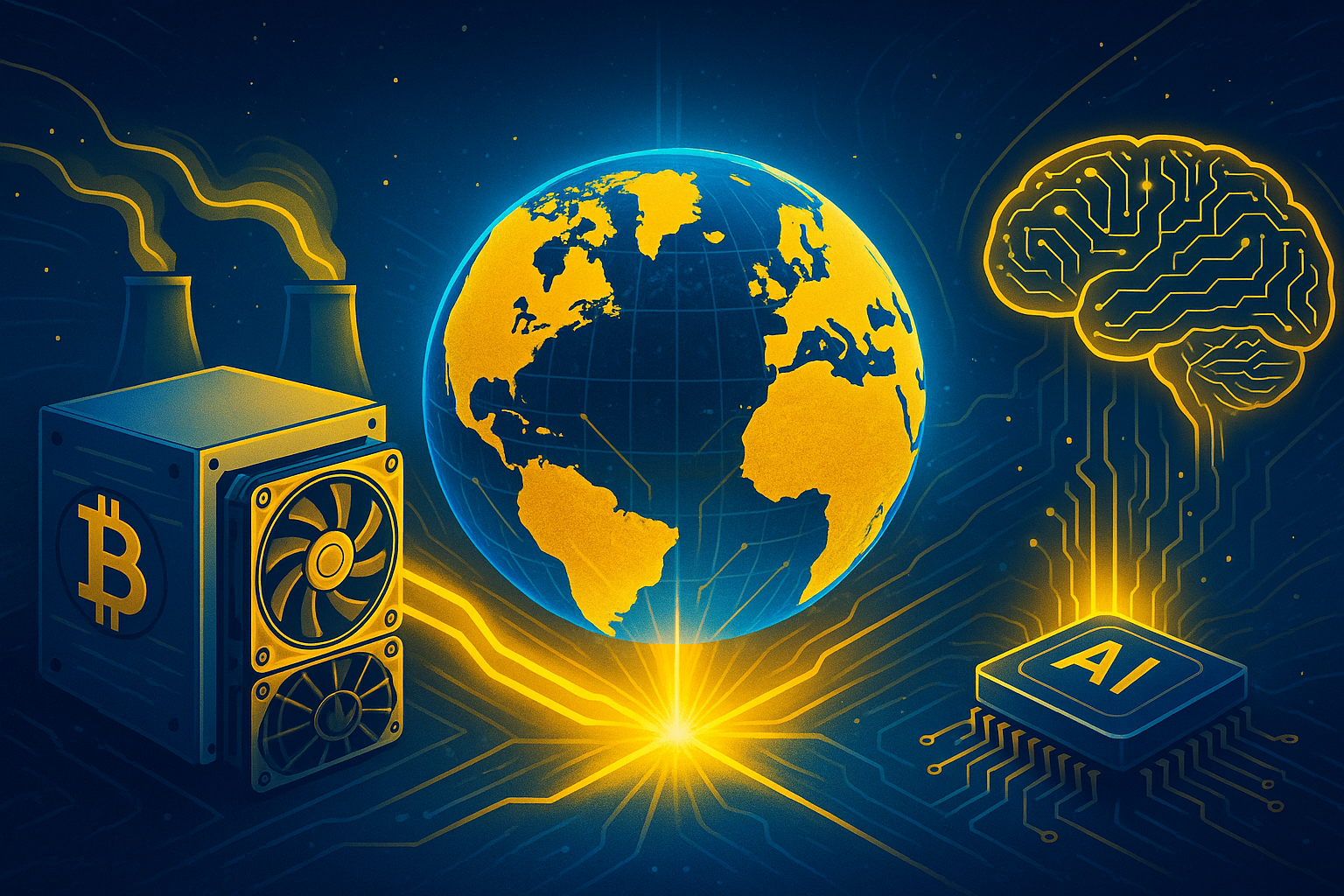
Yes, Bitcoin miners and AI computing can coexist and even complement each other. In fact, many large mining companies are beginning to run hybrid operations, leveraging their existing power capacity and infrastructure to host AI hardware alongside crypto mining. This approach provides a steadier income (through AI service contracts) while miners continue earning from Bitcoin, effectively getting the best of both worlds.
The Rise of Hybrid Operations
Not long ago, I was contacted by an AI startup looking for space to run their GPU servers. They knew my mining facility had power and cooling in place. That conversation made it clear: there’s mutual benefit in teaming up. I’ve since heard of multiple deals in the industry where miners and AI firms collaborate. A standout example is Core Scientific, one of the largest Bitcoin miners in North America. In 2023, while emerging from bankruptcy, Core Scientific struck an agreement to host over 200 MW worth of AI GPU servers for a client (the AI company CoreWeave). Fast forward to 2025, and CoreWeave actually acquired Core Scientific outright, turning a Bitcoin mining operation into a full-blown AI data center provider. That’s a dramatic case, but it underscores the trend – the lines are blurring between crypto mining companies and high-performance computing providers.
Other firms are taking a dual approach. For instance, Hive Blockchain (now Hive Digital) has been running traditional mining rigs while also operating GPU farms for cloud computing tasks. Bitfarms, a mining company in Canada, started exploring converting some of its sites (especially those with clean hydro power) into AI-friendly data centers. Even giants like Marathon and Riot, pure-play miners, have signaled interest in diversifying their compute uses. In my own experience, I’m considering dedicating a portion of our upcoming warehouse to AI servers if demand keeps growing. The strategy often looks like this: allocate maybe 10–20% of the power capacity to AI clients who sign long-term contracts, which brings in stable revenue, while the rest still mines Bitcoin. This way, if crypto markets go through a bear phase, the AI side provides a cushion. Conversely, if AI demand ever dips, the mining side is still there generating income.
Shared Infrastructure, Balanced Loads
There are also technical ways that Bitcoin mining and AI workloads can complement each other rather than compete. A fascinating idea is power load balancing between the two. AI training jobs can be very “spiky” – they ramp up usage when a model is training, then there might be idle or low-usage periods waiting for the next job or when models are in inference (which is less compute-intensive than training). Bitcoin miners have the advantage of being highly flexible demand – we can turn machines on or off within minutes. Some experts suggest mining could fill in the gaps when AI clusters are underutilized. For example, a data center could dedicate electricity to AI tasks when needed, but if there’s spare capacity at certain hours, they automatically switch that power to Bitcoin mining. This keeps the facility running at optimal load and monetizes every bit of available power. It’s like having two clients for your electricity instead of one – whichever has demand at a given moment uses it. I find this concept very appealing, as it could also help with grid stability (mining acting as a flexible load that can dial down during peak public demand, and dial up otherwise). In fact, some energy companies and regulators find this dual-use promising: mining can soak up excess energy when supply is high (or prices are low) and quickly power down if the grid is strained, a behavior that pairs well with intermittent renewable energy sources.
From an infrastructure standpoint, a hybrid operation means I might invest in beefier cooling and networking than a pure mining farm would, but those investments are justified by the diversified revenue. The valuation re-rating potential is another incentive. Investors tend to value data center or cloud businesses higher than plain mining. It’s been noted that mining firms trade at maybe 6–12 times their EBITDA, whereas data center companies trade at 20–25×. By integrating AI, a miner could see their stock market valuation climb as they’re viewed as a tech infrastructure play rather than a speculative crypto play. I’ve certainly noticed that narrative when talking to investors – the moment I mention AI, ears perk up and the venture capital folks start nodding.
Challenges and the Road Ahead
Running a dual operation isn’t without difficulties. I can attest that focus is important – doing one thing well is hard enough, let alone two. There’s a risk of stretching resources too thin or not fully meeting the needs of either client base. Also, the regulatory environment can differ. Some permits that allowed a site to be a “cryptocurrency mine” might need amendments or new approvals to offer cloud services or AI hosting. Local governments might have different rules or taxes for data center services. I’ve been doing homework on this for my region to avoid any legal pitfalls. Then there’s the human factor: a mining engineer and a machine learning engineer speak different languages (not literally, but in terms of technical jargon and priorities). Bridging that culture gap within a company means new training and hiring.
Despite these challenges, I am optimistic. The synergy is simply too good to ignore. We are at the start of what I’d call a convergence era. Bitcoin mining provided the first large-scale distributed compute infrastructure outside of Big Tech. Now AI is providing a huge new use case for compute. It feels like a natural evolution for these independent miners (like me) to grab a slice of the AI boom. By doing so, we also ensure that not all AI compute ends up centralized in a few tech giants’ hands – it can be more geographically and ownership-wise distributed, piggybacking on the decentralization that miners already have in their DNA.
One report noted that the line between “crypto mining company” and “data center operator” is fading fast, and I couldn’t agree more. In 2025 and beyond, I predict the most successful companies in this space will be those that can integrate both worlds. They will secure cheap power and run efficient operations (the miner mindset) while catering to diversified computing needs (the data center mindset). As for me, I’m preparing to be one of them – ensuring Miner Source (my company) can supply hardware and expertise for whichever direction the future pulls us.
| Category | Bitcoin Mining | AI Computing | Synergy / Joint Benefit |
|---|---|---|---|
| Core Role | Secure the Bitcoin network using ASICs | Train & run AI models using GPUs/TPUs | Use the same power + real estate for two revenue streams |
| Infrastructure Overlap | Large power capacity, basic cooling, simple networking | High-density racks, advanced cooling, high-speed networking | Mining sites provide ready megawatt-scale infrastructure for AI deployment |
| Revenue Model | BTC block rewards + transaction fees | AI hosting, compute rental, long-term contracts | Hybrid = stable AI contract income + mining upside |
| Leading Hybrid Examples | Marathon, Riot, Hive Digital, Bitfarms | CoreWeave (acquired Core Scientific), GPU cloud providers | 200+ MW deals between miners & AI firms (e.g., Core Scientific + CoreWeave) |
| Operational Flexibility | ASICs can power on/off instantly | GPUs run variable, spiky workloads | Miners act as flexible load balancers, filling idle AI power gaps |
| Location Advantage | Often located where power is cheapest | Needs strong power + fiber | Mining farms already have cheap power + land + permits |
| Load Balancing | Perfect for absorbing excess power or reducing load during peaks | Uses predictable power during training cycles | Dual-use improves grid stability and monetizes every kWh |
| Upgrade Path | Add cooling + networking to support AI servers | Add GPUs to existing racks | Mining farms can be retrofit for AI in 4–6 months, faster than 2–4 yr DC builds |
| Valuation Impact | Mining often valued at 6–12× EBITDA | Cloud/data centers valued 20–25× | Hybrid operations can lead to higher company valuation |
| Risk Factors | Crypto volatility; regulatory scrutiny | GPU scarcity; expensive infrastructure; data compliance | Diversification reduces risk on both sides |
| Skill Requirements | Electrical, cooling, ASIC maintenance | ML engineering, cluster management | Requires cross-disciplinary teams or partnerships |
| Regulatory Notes | Often under “mining” permits | Data centers have distinct regulations | Hybrid sites may need permit updates |
| Strategic Vision (2025+) | Decentralized compute + cheap power assets | Growing demand for distributed GPU compute | The future is converged facilities offering both mining + AI compute |
Conclusion
In 2025, AI computing is emerging as more profitable and fast-growing, but Bitcoin mining remains valuable in its own right – and the real win may come from blending the two. Both industries are driving innovation, and those of us at the intersection stand to benefit the most. 👉Contact MinerSource Team Purchase Now👈

