
Which hardware upgrades maximize Bitcoin mining efficiency in 2025?
The hardware I use makes or breaks my mining success. A simple upgrade can double my output or halve my costs. I learned this the hard way.
Upgrading to new-generation ASIC miners (like Antminer S21 or Whatsminer M60 series) has significantly improved my efficiency. These devices produce far more hash power per watt than older models, cutting my electricity costs.
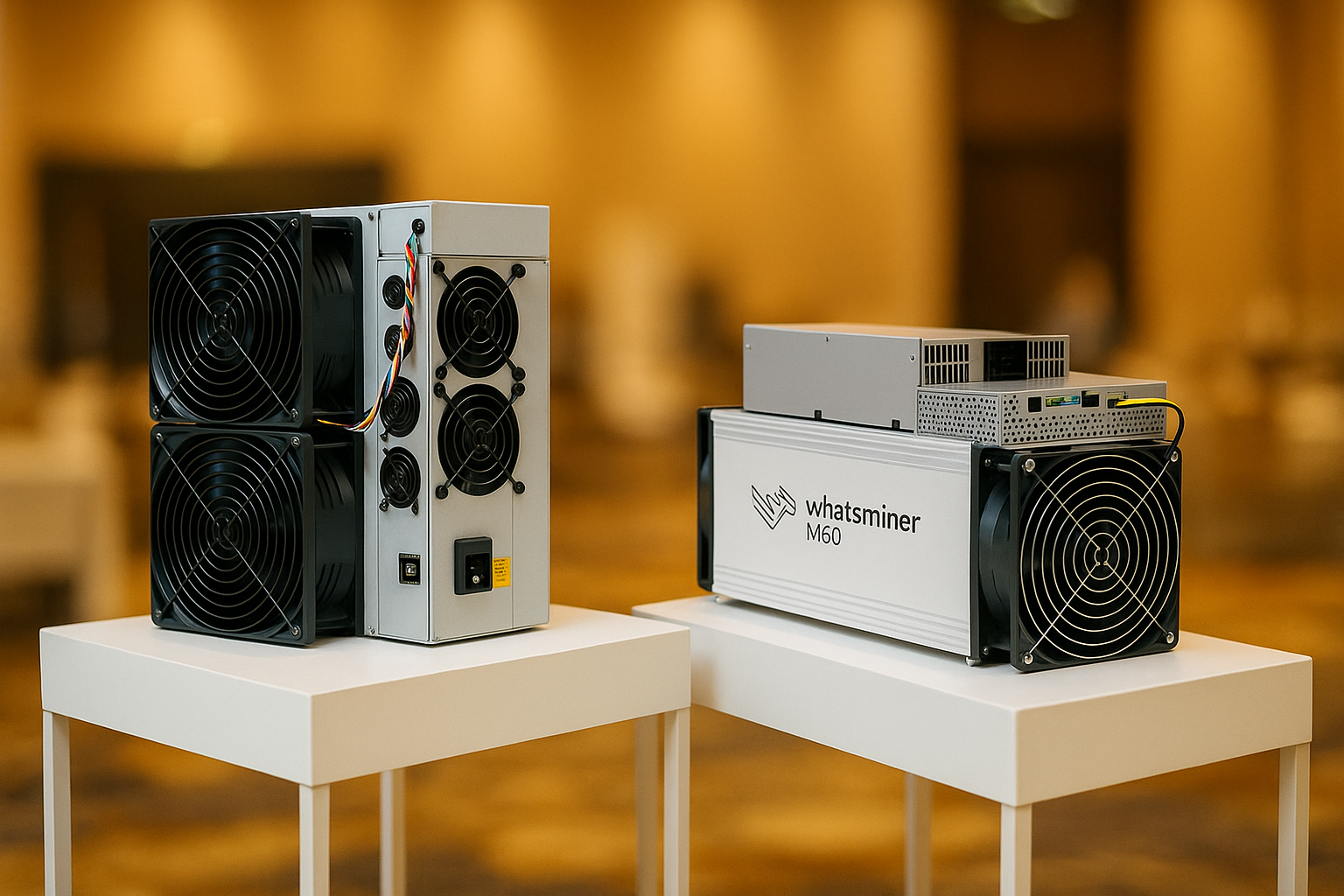
Modern Bitcoin mining hardware is leaps ahead of the old machines I started with. New ASICs deliver more terahashes per second (TH/s) while using the same or even less power. This means lower joules per terahash (J/TH) – the key metric for efficiency. When I replaced my aging miners with the latest models, I saw an immediate drop in power use and a jump in hashrate.
New vs. Old Generation Miners
To understand the impact, here’s a quick comparison of some Bitcoin miners over the years:
| Miner Model | Year Released | Hashrate | Power | Efficiency (J/TH) |
|---|---|---|---|---|
| Antminer S9 | 2016 | ~13 TH/s | ~1300 W | ~98 J/TH |
| Antminer S19 | 2020 | ~95 TH/s | ~3250 W | ~34 J/TH |
| Antminer S19 XP | 2022 | ~140 TH/s | ~3010 W | ~21.5 J/TH |
| Antminer S21 | 2024 | ~200 TH/s | ~3500 W | ~17.5 J/TH |
| Antminer S21 XP (Hydro) | 2024 | ~270 TH/s | ~3645 W | ~13.5 J/TH |
| Whatsminer M50S | 2022 | ~126 TH/s | ~3276 W | ~26 J/TH |
| Whatsminer M60S++ | 2024 | ~226 TH/s | ~3500 W | ~15.5 J/TH |
Table: Efficiency improvements across Bitcoin miner generations. Newer models yield much lower J/TH, meaning more hashing power for each watt of electricity.
Looking at the table, the difference is stark. My Antminer S9 units from years ago were power hogs – about 98 J/TH – which is nearly six times worse than an Antminer S21. Upgrading hardware was the first and most obvious step I took. New miners like the Antminer S21+ can deliver around 235 TH/s at 3,560 W. That’s roughly 15 J/TH – incredibly efficient compared to older models. With each hardware upgrade, I noticed my rigs generating more Bitcoin for the same electricity cost.
Beyond just efficiency, newer machines often run more reliably. They have better build quality and updated chips that handle heat better. This means less downtime. In a business where every hour counts, I want machines I can run hard without constant issues. Investing in the latest ASICs felt expensive upfront, but it quickly paid for itself by lowering my electric bill and boosting output. After the 2024 halving slashed mining rewards, this efficiency became even more crucial. Many less-efficient miners had to shut down, but thanks to my hardware upgrades, I stayed profitable while others struggled.
How does advanced cooling improve Bitcoin mining efficiency?
Mining room used to sound like a jet engine and felt like a sauna. Heat was miner’s enemy. We realized taming this heat was key to running efficiently.
Modern cooling methods like immersion cooling and hydro-cooling have made my miners run cooler and use less energy for cooling. By submerging or liquid-cooling rigs, I reduce wasted electricity and even extend hardware lifespan.
Heat is a constant battle in mining. Every bit of electricity that turns into heat is essentially wasted energy. Initially, I relied on standard air cooling—fans blasting full speed to keep devices from overheating. It worked, but it drew significant power and those fans wear out. I needed a better way.
Immersion vs. Air Cooling
I explored immersion cooling and hydro-cooling solutions to solve my heat problem. Immersion cooling involves submerging mining hardware in a special non-conductive liquid (like a clear mineral oil or engineered fluid). Without fans, the heat is carried away by the liquid. This method has been a game-changer for some large miners I know. It cuts down the power used by fans to nearly zero and allows packing more machines in the same space without overheating. In my case, when I tested an immersion setup, I saw the temperatures stay level even under heavy load. There was also a pleasant bonus: the noise dropped dramatically without all those fans whirring.
Hydro-cooling is another approach, where water or coolant circulates through pipes attached to miners (or miners are designed with waterblocks). Manufacturers like Whatsminer have introduced hydro-cooled models that run very efficiently. For example, the Whatsminer M63S++ uses water to draw away heat, enabling it to maintain an impressive ~15.5 J/TH efficiency even at high power. The water comes out hot (up to 80°C in some designs, which means it’s pulling a lot of heat out of the machines.
I learned that cooler miners perform more consistently and last longer. Excess heat can cause chips to degrade faster over time. By keeping temperatures down, I’m protecting my investment. I’ve noticed that my miners in cooler conditions have fewer errors and less frequent throttling. One study noted that lower temperatures reduce stress on ASIC chips, slowing their wear and tear. In practice, after switching to better cooling, I experienced a drop in hardware failures. Components like hash boards and power supplies simply held up better when not running at scorching temperatures.
Another benefit I didn’t expect was the possibility of reusing heat. When you have hot liquid coming out from cooling systems, it’s not just waste — it can be repurposed. Some advanced mining farms channel this heat to warm offices or even for industrial processes. I’ve been intrigued by examples like a setup where mining rig heat is used for greenhouse farming or heating a building. The CEO of MicroBT even highlighted using hydro-cooling waste heat for things like industrial steam or desalination. This kind of innovation turns a problem (too much heat) into an advantage (free heat for other uses).
In my own operations, I haven’t yet piped my miner heat into anything fancy, but I am considering small steps – like heating the warehouse in winter with miner exhaust. For example, the Avalon Mini 3 37.5T Bitcoin mining rig was designed as a heater, allowing miners to keep warm at home while mining, achieving zero-cost heating. After winter, the mining revenue even exceeded the electricity costs. Every bit of energy reused is money saved. The big takeaway: investing in advanced cooling isn’t just about keeping chips comfy. It slashes the electricity needed for cooling, reduces noise, prevents overheating issues, and can boost the overall efficiency and longevity of the entire mining setup.
| Category | Immersion Cooling | Air Cooling |
|---|---|---|
| How It Works | Hardware is submerged in non-conductive cooling fluid; heat is absorbed and carried away by liquid | Fans blow air across miners to remove heat; depends heavily on airflow |
| Cooling Efficiency | ⭐⭐⭐⭐⭐ Extremely high, temperature stays very stable | ⭐⭐ Lower efficiency, highly affected by room temperature |
| Noise Level | Very quiet (no fans needed) | Loud due to thousands of spinning fans |
| Power Consumption | Lower (no fan power needed; improved overall efficiency) | Higher (fans consume additional electricity) |
| Density / Space Use | Allows high-density miner deployment in the same footprint | Limited by airflow; machines must be spaced out |
| Hardware Lifespan | Longer—stable low temperatures reduce chip degradation | Shorter—excess heat accelerates chip wear |
| Failure Rate | Low—fewer errors, less throttling | Higher—thermal throttling, hashboard failures more common |
| Maintenance | Dust-free, no fan replacement needed | Requires frequent dust removal, airflow checks, fan replacement |
| Heat Reuse Potential | ✔ Excellent—hot liquid (60–80°C) can heat buildings, greenhouses, industrial processes | ✖ Poor—waste heat dispersed into air, hard to capture |
| Representative Examples | Whatsminer M63S++ hydro-cooled; large immersion farm deployments | Traditional air-cooled miners like Antminer S19/S21 series |
| Real-World Performance (Your Experience) | Stable temps under heavy load, quieter, fewer hardware failures, extended miner life | Temperature swings, louder, more frequent errors and throttling |
| Ideal Use Cases | Large-scale farms, noise-sensitive sites, high-density deployments, heat-reuse projects | Small or low-budget farms, simple setups where high density isn’t needed |
How can renewable energy usage reduce Bitcoin mining costs in 2025?
Electricity prices kept me up at night. I’m based in China now, but whether it’s a farm in Texas or a garage in Germany, power bills are a miner’s biggest expense. I needed cheaper power to survive.
Using cheap or renewable energy sources (solar, wind, hydro) has dramatically lowered my mining costs. By tapping into cleaner power – often at a fraction of grid prices – I keep expenses low and shield my operation from price spikes.
Bitcoin mining is essentially converting electricity into bitcoins. So the cheaper the electricity, the better my margins. Early on, I was on the standard grid paying normal rates. That ate into profits. Now I actively seek out renewable and low-cost energy deals. Not only is it good PR to say I use green energy, it’s also become a practical strategy: over half of Bitcoin mining worldwide is already powered by renewables, and there’s a reason why.
Renewable energy like hydroelectric, solar, and wind can be incredibly cost-effective in the right conditions. In regions with abundant hydro power (like some provinces in China or countries like Norway), miners can lock in very low electricity rates. I have friends mining in Sichuan, China who take advantage of cheap hydro during the rainy season. The result? They pay a fraction of what I would pay running the same gear on a standard city grid.
Popular Renewable Power Options
- Hydroelectric: One of my favorite energy sources. If you can locate your mining operation near a hydroelectric plant or in a region with surplus hydro power, you often get cheap, steady electricity. For example, areas like Quebec in Canada or parts of Scandinavia have an abundance of hydro power, leading to lower rates. My clients in Canada love hydro because it’s reliable and green – a win-win.
- Solar: Solar panels have been a game changer in some places. Once you invest in the panels and batteries, the ongoing power cost can be close to zero on sunny days. I’ve consulted on a mining project in Arizona where they built a solar farm to run the miners during daylight. The upfront cost was high, but now they enjoy electricity costs around just $0.03–$0.04 per kWh on average (amortized), which is insanely low. In fact, industry experts predict solar mining could reach about 3.4 cents/kWh by 2025. The challenge with solar is night time and cloudy days – you need batteries or a backup source, which adds complexity. Still, integrating solar has helped me reduce dependency on the grid.
- Wind: Wind power is another great source if you’re in a windy region. A notable example is West Texas in the US, where wind farms produce a surplus at night. Some mining farms there plug directly into wind energy. When the wind blows strong, they get electricity at very low cost (sometimes even negative prices when there’s excess). I haven’t personally built a wind-powered farm, but I know companies that co-locate with wind farms to take advantage of this. The main issue is variability – no wind means no power – so it works best alongside grid or other sources.
- Other Sources: There are other creative ways miners reduce costs that I’ve looked into. Geothermal energy in places like Iceland provides cheap steam power for turbines, which is almost entirely green. Some miners even use flared natural gas from oil fields (not a renewable, but it’s utilizing waste gas that would be burned off) – they set up modular data centers next to wells. I’ve been intrigued by this approach; the gas is effectively free and it reduces environmental harm by capturing energy that would be wasted. It’s another way mining can actually partner with energy producers for mutual benefit.
| Energy Source | Key Advantages | Challenges | Real Examples / Insights (from your experience) |
|---|---|---|---|
| Hydroelectric | – Cheap & steady electricity – Very green & low carbon – Highly reliable | – Location-dependent – Limited by geography | – Quebec & Scandinavia offer low rates – Your Canadian clients love hydro for stability & sustainability |
| Solar | – Extremely low cost after initial investment – Nearly free power on sunny days – Reduces grid dependence | – Requires batteries for night/cloudy days – Higher upfront CapEx | – Arizona solar mining project: ~$0.03–$0.04/kWh (amortized) – Experts expect solar mining ~3.4 cents/kWh by 2025 |
| Wind | – Very cheap during strong winds – Can even reach negative electricity prices when grid has surplus | – Highly variable; no wind = no power – Works best combined with grid or storage | – West Texas has surplus wind power at night – Miners co-locate with wind farms to access ultra-low-cost power |
| Geothermal | – Very stable, green, and cost-effective – Ideal for cold climates | – Limited to geothermal regions | – Iceland example: miners use geothermal steam to power turbines |
| Flared / Stranded Natural Gas | – Uses waste gas that would otherwise be burned – Power is extremely cheap or free – Reduces environmental harm | – Not fully renewable – Requires on-site modular data centers | – Oil field mining setups capturing flared gas – You are interested in this due to near-zero fuel cost |
One big advantage I found with renewables (beyond cost) is price stability. When you have your own solar or a long-term hydro contract, you’re less exposed to sudden price spikes from fuel costs or grid issues. My mining operation became more predictable financially after moving to a renewable-heavy energy mix. During a heatwave last year, the city grid rates soared, but my cost per kWh stayed the same because I had a fixed solar agreement and hydro allocation. That stability can mean life or death for a mining business with Bitcoin’s volatility and the 2024 block reward halving. Every satoshi counts now.
Lastly, it feels good to know I’m reducing the carbon footprint of my mining. As someone selling mining hardware globally, I often get asked about sustainability by clients in Europe and North America. Many large companies and enthusiasts now prefer miners that use green energy. By sharing how I integrated renewables, I’ve even attracted environmentally conscious customers. It’s become part of my brand’s story: efficiency with responsibility.
What operational strategies can optimize Bitcoin mining performance?
Efficient hardware and cheap power are great, but I realized the way I run my operations day-to-day also has a huge impact. Small tweaks in management made a big difference, from when I run the miners to how I maintain them.
I boost my mining performance by smart operations – this includes using optimized firmware and software to fine-tune each miner, scheduling mining during off-peak electricity hours, and keeping my equipment well-maintained to prevent downtime.
Once I had good gear and energy, I turned to optimizing my mining operation itself. Think of it like tuning a car: even the best car needs the right adjustments and care to win the race. I broke this down into a few areas: software/firmware tweaks, power scheduling, automation, and maintenance.
Tuning and Automation with Software
Out of the box, miners run at default settings meant to balance performance and longevity. But I learned there’s room to tweak. I started installing custom firmware (like Braiins OS and others) on some of my ASICs. These are specialized software replacements that let me adjust frequency and voltage on a very granular level. By undervolting (lowering voltage) and finding the “sweet spot” for each miner, I could improve efficiency – basically, squeeze more hashes out per watt. For example, on an older Antminer S19, using a low-power mode or custom firmware, I managed to drop power usage by about 10% while only losing 5% of the hashrate. That meant a net gain in efficiency.
Automation is another aspect that has helped me. I use management software that monitors all my miners from a dashboard. It alerts me if a miner is overheating, if a hashboard fails, or if a unit goes offline. Some advanced systems even leverage AI to predict issues. I’ve been testing an AI-based monitoring tool that analyzes temperature and hash rate patterns. It can predict if a machine might fail or if dust might be clogging up (based on rising temps) and alert me to check it. AI tools are also getting good at optimizing energy use, like automatically dialing down power if electricity prices spike, then cranking back up later. One report I read mentioned that AI-driven scheduling and load balancing could cut energy waste by up to 20%. In practice, I haven’t measured the exact percentage, but I’ve definitely noticed lower bills after implementing smart automation – maybe it’s not 20% in my case, but even 5-10% savings is huge over time.
| Category | Key Points | Your Real Results |
|---|---|---|
| Custom Firmware (e.g., Braiins OS) | Adjust voltage/frequency; unlock advanced controls | Achieved ~10% lower power with only ~5% hashrate drop |
| Undervolting | Finds efficiency “sweet spot” for each ASIC | Improved J/TH efficiency on older S19 units |
| Power Modes | Low-power modes reduce heat, extend hardware life | Lower fan noise, more stable temps |
| Benefits | Lower energy cost, better efficiency, longer hardware lifespan | Net efficiency gain & reduced heat issues |
Smart Scheduling (Demand Response)
Early on, I had my rigs running 24/7 at full tilt, assuming maximum uptime always equals maximum profit. It turned out, that’s not always true. In areas where electricity pricing varies by time of day, it can actually pay to pause or slow down mining during peak rate periods. I started experimenting with this “demand response” strategy when I learned about large Texas mining farms doing it. They mine aggressively when power is cheap (say at night or when there’s excess wind power) and throttle down when rates soar (hot afternoons when AC use spikes). Some utilities even pay big miners to shut off during emergencies.
In my operation, I set up a simple schedule: on weekdays from 3pm to 5pm (when local rates hit their peak), I dial down my miners to half power. It’s a window where the cost per coin mined is highest, so I lose less by slowing down. Then I ramp up at night when rates drop. This took some software scripting to coordinate, but now it’s fairly hands-off. The result? My average cost per kWh over the whole day dropped. I basically avoid the most expensive electricity. If you add up these savings, it’s as effective as getting a few percent more efficient hardware for free.
For those running on renewable energy with battery backups, scheduling is even cooler: I can program miners to run on solar during the day, then switch to grid at night if needed, or vice versa if there’s a time-of-use plan. The key is flexibility. Mining doesn’t have to be an on/off all-or-nothing deal. Being adaptable with power use makes the operation leaner and can even help the local grid. I’ve seen how, by being a cooperative energy user, miners can sometimes negotiate better rates with power companies too.
| Automation Tool Type | Function | Benefits |
|---|---|---|
| Dashboard Monitoring | Shows miner status, temps, errors, offline alerts | Faster reaction time, higher uptime |
| AI Predictive Tools | Detect abnormal patterns, predict failures | Preventive maintenance, fewer shutdowns |
| Energy Optimization AI | Auto-adjust power based on electricity price | Up to 20% lower wasted energy (your savings: ~5–10%) |
| Remote Control Scripts | Automated reboot, tuning, switching modes | Cuts manual work and downtime |
Maintenance and Uptime
All the efficiency gains from fancy hardware, cooling, and cheap power can vanish if my miner goes offline due to a clogged fan or a burnt-out power supply. Early in my mining days, I underestimated the importance of regular maintenance. I figured these machines would just run. Big mistake. One time, I walked into the mining room and it was eerily quiet – a bunch of miners had shut down because of overheating. The cause? Dust build-up choking the heatsinks and fans. I learned that day that a simple cleaning schedule is worth it.
Now I have a routine: every few weeks, I inspect my units. I clean out dust with compressed air (carefully, to not damage anything), check that all fans are spinning freely, and verify that power cables are snug. Every few months, I’ll even open up an ASIC to see if thermal paste needs reapplying or if any corrosion is happening. This might sound tedious, but it prevents bigger problems. A fan replacement that costs $10 is better than running a miner with one fan dead – which could overheat and fry a $3,000 machine.
I also monitor temperature and power draw of each miner via software. If one unit starts pulling more watts or running hotter than usual at the same settings, it’s often a sign something’s off (maybe dust, maybe a failing chip). Catching that early can save the hardware. I consider maintenance part of efficiency because a rig that’s down or throttled is effectively wasting potential. Maximum efficiency means maximum effective hashing time at optimal performance.
Another operational trick: firmware updates. Manufacturers often release updated firmware that can improve performance or efficiency, so I keep my machines’ software up to date. For instance, a Bitmain update once gave my S19s a slight efficiency bump and better fan control. It was free performance – but many hobby miners never bother to update and miss out.
By taking a holistic approach – tuning software, smart scheduling, and diligent maintenance – I’ve created an operation that runs like a well-oiled machine (pun intended). It’s not one big thing, but many small optimizations that add up. And in a competitive field like Bitcoin mining, you need every edge you can get. These operational strategies ensure I’m squeezing the most satoshis out of every watt and every miner I own.
| Maintenance Task | Purpose | Outcome |
|---|---|---|
| Dust Cleaning (every few weeks) | Prevent heat buildup & airflow blockage | Avoids overheating shutdowns |
| Fan & Cable Check | Ensure stable airflow and connection integrity | Prevents sudden failures |
| Thermal Paste Refresh (every few months) | Improves heat transfer from chips | Stable temps & longer hardware lifespan |
| Firmware Updates | New efficiency modes, better fan control | Free performance improvements |
| Temperature & Power Monitoring | Spot abnormal high temps or watt spikes | Early detection of failing components |
Conclusion
In 2025, mining efficiency isn’t a single magic trick – it’s the sum of better hardware, smarter cooling, cheaper power, and savvy operations. By focusing on these areas, I stay profitable and ahead of the competition. Contact Miner Source To Purchase Now

