
How Cheap Is Iranian Electricity, Really?
To understand Iran, you have to understand its energy math. This country sits on the world’s second-largest natural gas reserves. But because of international sanctions, they cannot easily sell that gas to the world. So, they use it to generate cheap domestic power.
The numbers are extreme. Industrial rates for licensed miners are about $0.007 per kilowatt-hour during most of the year, and some reports put illegal connections as low as $0.004. To mine one Bitcoin, you need roughly 2,000 to 3,000 megawatt-hours of electricity. In Iran, that costs you about $1,320. In the US, that same power bill could be $40,000 or more.
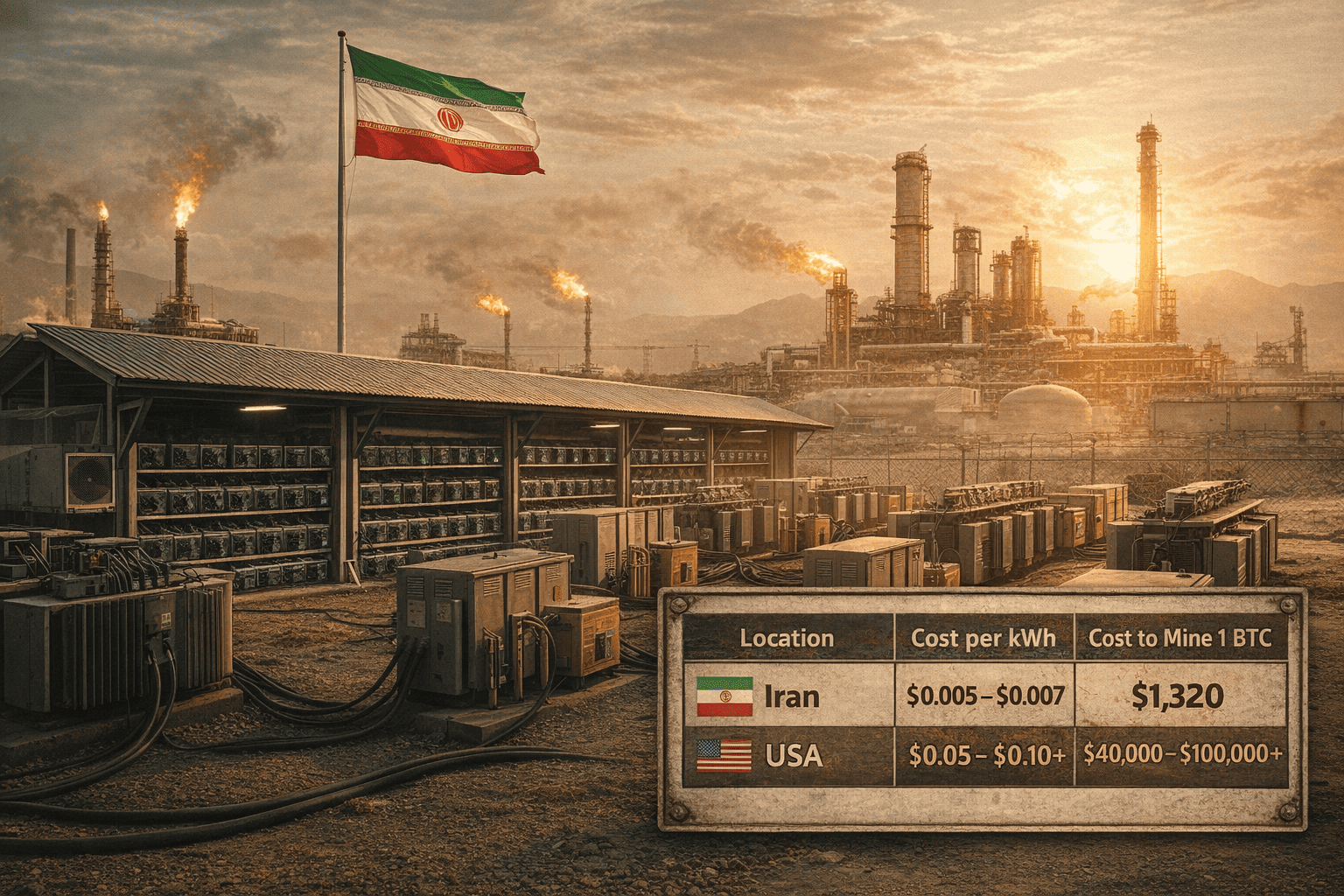
Breaking Down the Cost Advantage
Let me put this into a table so you can see the gap clearly. These are approximate figures based on early 2026 data:
| Location | Est. Cost per kWh | Est. Cost to Mine 1 BTC | Profit Margin (at $68k BTC) |
|---|---|---|---|
| Iran (Subsidized) | $0.005 – $0.007 | $1,320 | 98% |
| Iran (Summer Rates) | $0.07 | Higher, but still low | Varies |
| United States | $0.05 – $0.10+ | $40,000 – $100,000+ | 40% – 0% |
| Europe | $0.1+ | Often unprofitable | Negative |
- The “Peak Summer” Trap: The Iranian government is not stupid. They know miners love their cheap power. So, they introduced a variable rate. From June to September, the price jumps to $0.07 per kWh to discourage mining during peak demand.
- The Group Discount: Here is a detail most people miss. If you operate as a group or with very high capacity, you can get up to a 20% discount on top of the already low rates. The government wants big, controllable players, not small backyard operations.
What Is the Catch with Regulations and the Central Bank?
Okay, so you are sold on the power prices. You want to go the legal route. What happens next? Iran legalized mining back in 2019 for a very specific reason. They needed a way to earn foreign currency to pay for imports without using the US banking system.
The catch is simple but huge. If you get a license, you are basically working for the government. You must sell all the Bitcoin you mine directly to the Central Bank of Iran at a price they determine. You are not a free miner. You are a contractor for the state.
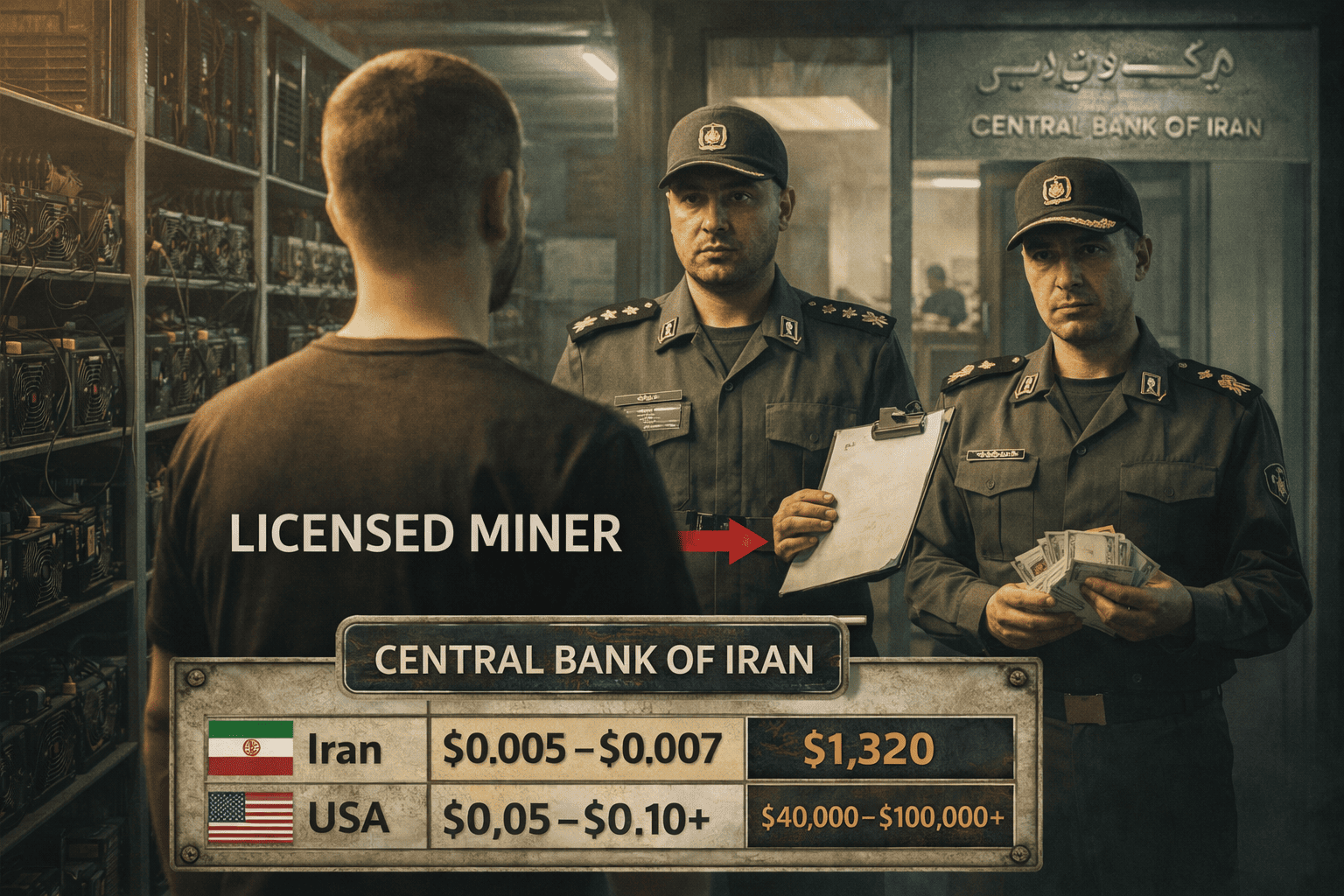
The Licensing Trap
Let me walk you through the logic of why this is a problem.
- The Government’s Goal: They want to bypass the SWIFT system. They take your BTC, sell it on the open market for US dollars (probably through exchanges in Dubai or Turkey), and use that cash to buy food, medicine, or machinery.
- The Miner’s Reality: You get access to subsidized power. But you lose all control over your product. You cannot HODL your coins and wait for the price to hit $100,000. You sell when they tell you to sell.
What Happens If You Say No?
This is where it gets gray. Experts estimate that up to 85% to 90% of the mining in Iran happens without a license.
- The Underground Economy: These “underground” miners do not ask for permission. They tap directly into residential power lines, mosques, schools, or industrial zones without authorization.
- The Risk: If you get caught, they seize your machines. The government even offers rewards, reportedly around $725, for people who report illegal mining farms.
- The Cat and Mouse Game: Miners now use VPNs to hide their online activity and rent empty apartments to spread out their machines, making them harder to detect.
Who Are the Real Players in Iran’s Mining Market?
During my chat with that Iranian wholesaler yesterday, he told me something that really stuck. Right now in Iran, the people who are best suited for mining aren’t the big companies trying to get licenses, and they aren’t the high-risk speculators running underground factories. It’s the ordinary Iranian citizens.
Because of government restrictions and regulatory pressure, large mining farms have become obvious targets. But residents running a few machines quietly from their homes? That has become an “invisible” business. This is the real face of Iranian mining today.

How Do Residents Mine? With “Silent Boxes”
He painted a picture for me that I can’t get out of my head.
- Small Scale, Easy to Hide: Ordinary Iranian residents aren’t buying hundreds of machines. They usually buy just a few, maybe a dozen at most.
- Silence is Key: Mining machines are noisy. If neighbors hear them, they might report you. So, they put the miners inside “silent boxes.” These are specially made soundproof enclosures that drastically reduce the fan noise.
- Where Do They Put Them? Balconies, basements, storage rooms—anywhere they can plug into the power grid without disturbing daily life.
Think about it. An average family, using the government-subsidized residential electricity rate (which is still incredibly cheap, even if a bit higher than industrial rates), puts a few machines in silent boxes. No one notices. The police don’t come knocking. And every month, they have a steady stream of extra income in US dollars. In Iran’s current economy, that is the perfect side business.
The Wholesaler’s Buying Logic
That wholesaler came to me specifically to buy a large quantity of used mining machines. He specifically asked for two models: the M30S+ and the M30S++. And he only wanted Whatsminer, no Antminers. I asked him why, and he explained.
Why Is Whatsminer More Popular Than Antminer in Iran?
This was something I hadn’t really thought about before. In my mind, Antminer has always been the market leader. But in this Iranian wholesaler’s eyes, it was the complete opposite. He told me that in Iran, Whatsminer has a much better reputation than Bitmain.
Because Iran’s climate is hot, and the cooling conditions in a regular home are nowhere near as good as in a professional mining farm. In this high-heat environment, Whatsminer machines run much more stable. Their failure rate is much lower. For a resident, a machine that doesn’t break down is the biggest money-saver of all.
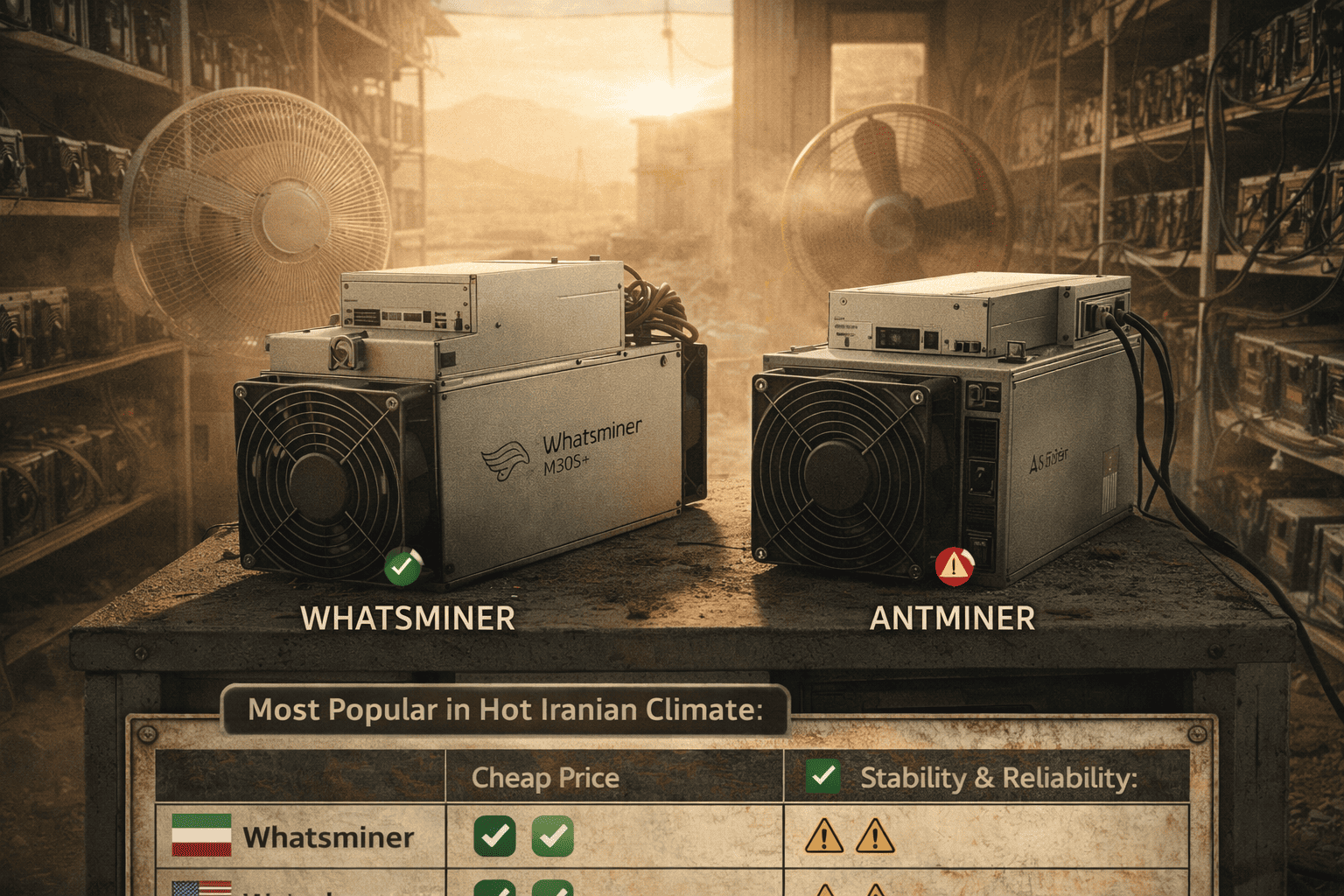
Stability in High Heat
Let me put his points into a table so it’s easier to see:
| Comparison Point | Whatsminer (e.g., M30S++) | Antminer (e.g., S19 Series) |
|---|---|---|
| Performance in High Heat | Very stable, runs for long periods without issues | More sensitive to temperature, prone to problems in summer |
| Failure Rate | Very low, residents don’t have to worry about repairs | Relatively higher, needs more frequent maintenance |
| Reputation in Iran | More popular, known for being durable and reliable | Not as good as Whatsminer |
His exact words were: “The residents back home, they just want a machine you turn on and forget about. If it breaks down every few days, they can’t deal with that. Whatsminer is much better than Bitmain in this regard.”
Cheap Power Changes Everything About Choosing a Machine
One more thing he said really stuck with me. He told me that the logic for choosing a mining machine in Iran is completely different from anywhere else in the world.
- Everywhere else: People look at efficiency first. Power consumption matters. Because electricity is expensive, saving power means saving money.
- In Iran: Electricity is so cheap, it’s practically irrelevant. So, nobody cares how much power a machine uses or how efficient it is. They only care about one thing: Which machine is the cheapest?
Think about it. At $0.005 per kWh, does a few hundred watts of extra power consumption really change the bottom line? Not at all. So why pay a premium for the newest, most efficient machines? It makes no sense. Buy the cheapest machines, use the cheapest power, and your payback period is shorter than someone using new machines in the US. That is the unique logic of the Iranian market.
| Region | #1 Priority When Choosing a Miner | #2 Priority | Core Reason |
|---|---|---|---|
| North America/Europe | High Efficiency, Low Power Consumption | High Hashrate | Electricity is expensive; saving power saves money |
| Iran (Residents) | Low Price | Good Stability, Low Failure Rate | Electricity is incredibly cheap; power consumption doesn’t matter |
So, that wholesaler wanted to buy used M30S+ and M30S++ machines. Not because they are the most efficient, but because they offer the best value, stability, and the lowest price on the second-hand market. They are a perfect match for the needs of Iranian residents: low entry cost, steady returns, and no hassle.
Conclusion
So, is Iran the best country for Bitcoin mining? I can give a more specific answer now.
- For the average Iranian resident: Yes, this is the best place. A few machines in silent boxes, plugged into the cheap home grid, provides a steady extra income every month. They are the real winners in this game.
- For large companies seeking a license: It’s risky. You’re basically working for the government and lose control of your assets.
- For foreign investors: The risk is extremely high. No matter how tempting the hashrate is, you could lose everything in a single seizure.
When that wholesaler left, he confirmed his next order with me. He still wanted the M30S series. Because he knows that in Iran, cheap power makes cheap machines the priority, and the hot weather makes stable machines a must. Whatsminer fits both needs perfectly.
If you are keeping an eye on the Iranian market, or if you want to know more about the pricing for used M30S series machines and just how cheap they really are, feel free to contact us anytime: https://wa.me/8613871817151
Let’s talk and see how we can connect you with the demand in this unique market.


