
Why Are People So Worried About Quantum Computers and Bitcoin?
I get asked about this almost every week now. It started around 2020 when Google claimed “quantum supremacy.” Suddenly, my clients in Canada and Europe started sending me articles. They wanted to know if the machines I sell them would become useless overnight. I had to dig into the actual science to give them real answers.
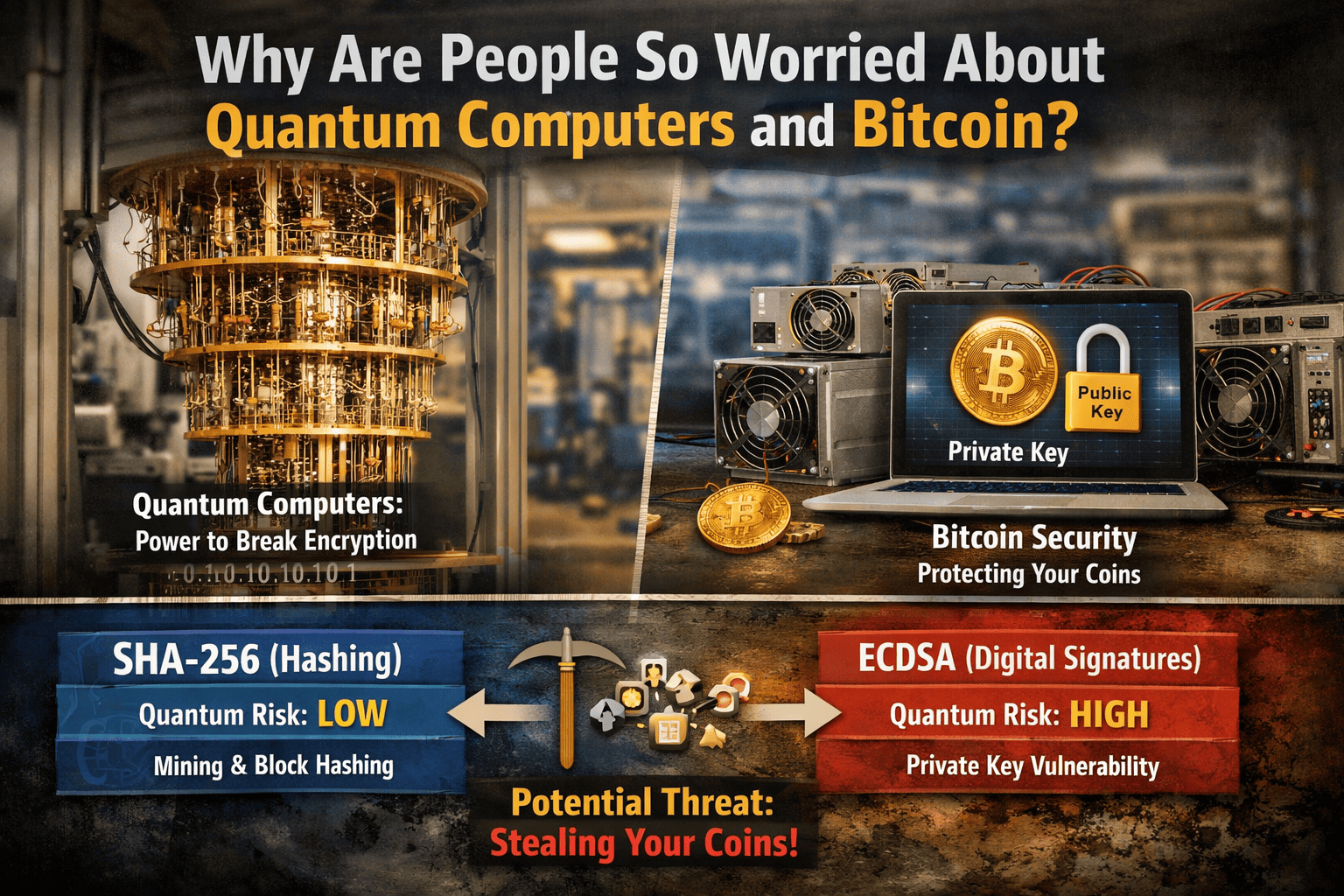
The worry comes from a simple fact: quantum computers work completely differently than normal computers. Normal computers use bits. Bits are either 0 or 1. Quantum computers use qubits. Qubits can be 0, 1, or both at the same time. This gives them insane potential power for certain tasks. One of those tasks is breaking encryption. Bitcoin relies on two types of encryption: hashing and digital signatures. If a quantum computer gets powerful enough, it could theoretically reverse-engineer your private key from your public key. That would let someone steal your coins.
What specific Bitcoin encryption is at risk?
Let me break this down simply. Bitcoin uses two main cryptographic techniques. I want to explain both so you understand exactly what is vulnerable.
This is what miners do. We run SHA-256 millions of times per second to find blocks. This is the “work” in proof-of-work.
- Quantum threat level: Low.
- Why: Grover’s algorithm (a quantum algorithm) could theoretically speed up hash searching. But the fix is simple. We could just increase the hash length. It is not a fatal flaw.
Elliptic Curve Digital Signature Algorithm (ECDSA)
This is how you prove you own your Bitcoin. Your private key signs a transaction. Your public key verifies it.
- Quantum threat level: High.
- Why: Shor’s algorithm (another quantum algorithm) could theoretically derive a private key from a public key. If someone can do that, they can steal your coins.
| Encryption Type | Used For | Quantum Risk | Easy To Fix? |
|---|---|---|---|
| SHA-256 | Mining / Block Hashing | Low | Yes (longer hashes) |
| ECDSA | Signing Transactions / Ownership | High | Yes (new signature scheme) |
So the real danger is not to mining itself. The danger is to the ownership system. That is why people get nervous. If quantum breaks ECDSA, the whole concept of “your coins” falls apart.
How Would Quantum Computers Actually Steal Your Bitcoin?
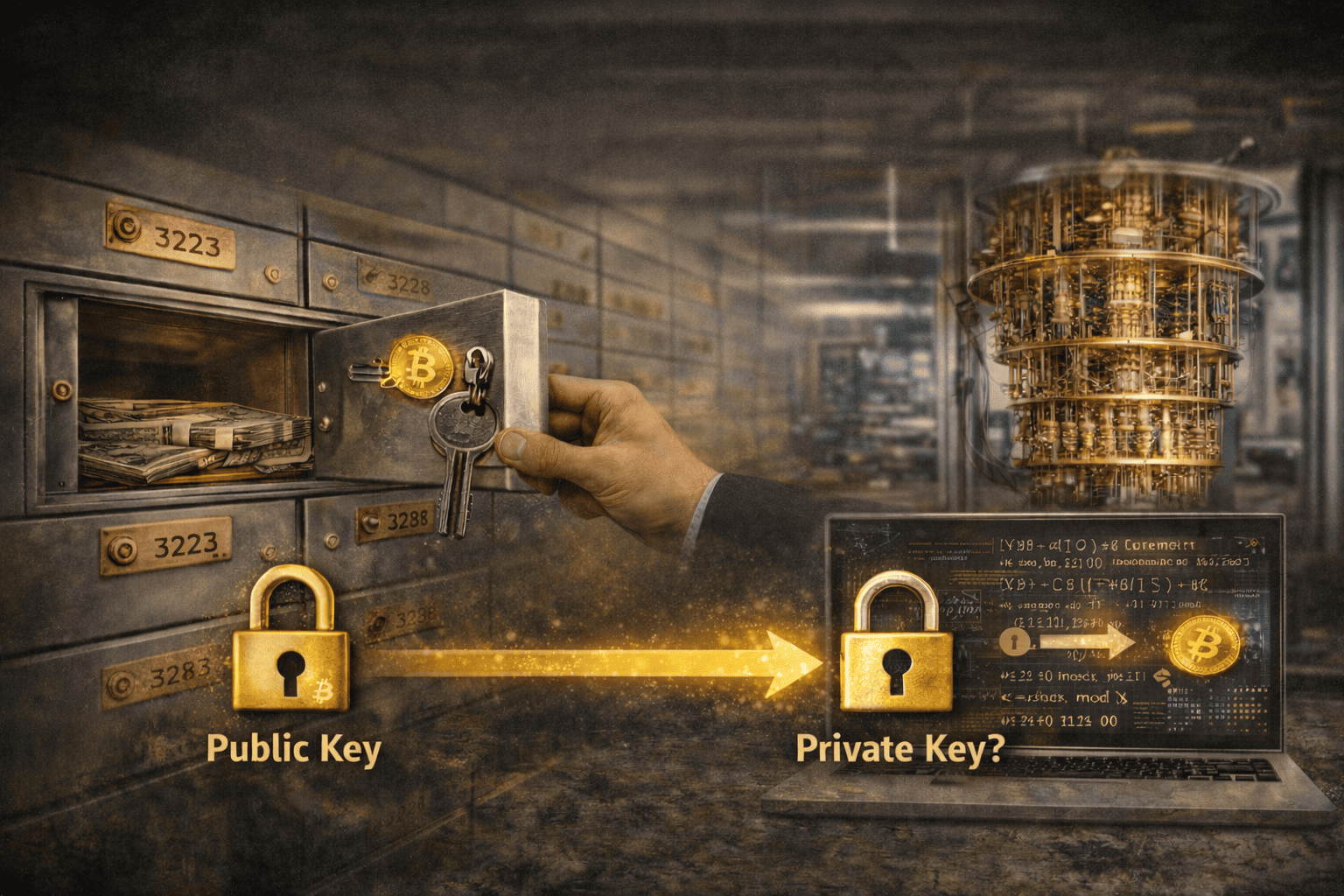
When I explain this to buyers at my Hong Kong office, I like to use a simple analogy. Think of your Bitcoin address like a safe deposit box at a bank. The public key is the box number. Everyone can see it. The private key is the actual key to open the box. Right now, it is impossible to figure out the key just from looking at the box number. Quantum computing changes that math.
A quantum computer powerful enough to run Shor’s algorithm could do something remarkable. It could take your public key (which is visible on the blockchain for every transaction you have ever made) and calculate your private key from it. It would not take millions of years like a normal computer. In theory, it could do it in minutes or hours. Once someone has your private key, they can move your coins to their own address. The transaction would look completely valid to the network. The real owner would have no way to get them back.
Would this happen instantly to everyone?
This is where the details get interesting. I spent an afternoon talking with a cryptography researcher last year. He pointed out something I had not considered. The attack would not happen to all Bitcoin addresses at once.
Addresses with exposed public keys are the most vulnerable.
Let me show you what I mean.
Bitcoin Address Types and Their Risk
| Address Type | Public Key Exposure | Quantum Risk Level |
|---|---|---|
| P2PK (Pay to Public Key) | Always exposed on blockchain | Highest Risk |
| P2PKH (Pay to Public Key Hash) | Exposed only when you spend | Medium Risk |
| P2SH (Pay to Script Hash) | Varies based on usage | Medium Risk |
| Bech32 (SegWit) | Exposed only when you spend | Medium Risk |
Here is the key point. If you have a Bitcoin address that has never sent funds out, your public key is probably still hidden. It has been hashed. An attacker cannot see it. But the moment you make a transaction from that address, you reveal your public key to the world. At that moment, your coins become vulnerable to a future quantum attack.
This is why some security experts suggest moving old coins to new addresses periodically. It limits exposure. But for most of us, this is not an urgent issue yet.
When Will This Happen? What Is The Real Timeline?
I wish I could give you an exact date. But nobody can. I have read reports from IBM, Google, and Chinese research labs. I have listened to podcasts with quantum physicists. The estimates vary wildly. Some say 10 years. Some say 50 years. Some say it will never happen because the engineering problems are too hard.
Most experts agree on one thing: we are not close. To break Bitcoin’s ECDSA, you need a fault-tolerant quantum computer with millions of physical qubits. The current world record for qubits is around 1,000. And those qubits are noisy. They make errors. They need error correction. To get one stable “logical” qubit, you might need thousands of physical qubits. So the math is simple. We need billions of physical qubits. We have hundreds. We are nowhere near the goal.

What milestones should we watch for?
I track this topic closely because my business depends on crypto’s future. I look for specific signs.
The Q-Day Milestones
- Milestone 1: A lab demonstrates 1,000 stable logical qubits running Shor’s algorithm.
- Status: Not even close. We have 0 stable logical qubits running Shor’s at scale.
- Milestone 2: A research team breaks a 1024-bit RSA key.
- Status: The largest RSA key broken by quantum was 22 bits. 1024-bit is still science fiction.
- Milestone 3: A team demonstrates an attack on a real cryptocurrency testnet.
- Status: Has not happened. No one has even tried seriously.
- Milestone 4: Quantum computers become commercially available for encryption breaking.
- Status: Decades away.
I tell my clients to relax. We will see these milestones years before any real danger appears. The crypto community will have time to react. There will be warnings.
What Is The Crypto Industry Doing To Prepare?
This is the part that gives me confidence. I have seen this industry adapt before. When China cracked down on mining in 2021, everyone thought it was over. But we just moved. We set up warehouses in new countries. We found new partners. The industry is resilient.
The crypto industry is already working on quantum-resistant cryptography. Developers are researching new signature schemes that quantum computers cannot break. These are called post-quantum cryptography (PQC) algorithms. The National Institute of Standards and Technology (NIST) in the US is running a competition to select the best ones. They have already chosen several finalists. Once the standards are ready, cryptocurrencies can upgrade.
How would Bitcoin upgrade to be quantum-safe?
This is a fascinating technical question. Bitcoin is decentralized. Upgrades are hard. But they are possible.
Potential Upgrade Paths
| Method | Description | Difficulty |
|---|---|---|
| Soft Fork | Introduce new quantum-resistant address types. Old addresses remain vulnerable but usable. Users must move funds voluntarily. | Medium |
| Hard Fork | Mandatory network-wide upgrade to new signature scheme. All coins must be moved or they become stuck. | High |
| Emergency Hard Fork | If an attack is happening, developers could freeze the blockchain and require key migration. | Extremely High |
I think the most likely path is a soft fork. It gives people time. It lets early adopters move first. It is how Bitcoin has handled other upgrades. The community will discuss it for years. Then they will implement it slowly. That is the Bitcoin way.
Should Bitcoin Miners Like Us Be Worried?
This hits close to home for me. I run Miner Source. I sell Antminers and Whatsminers to farms all over the world. If quantum computing killed Bitcoin, my business would disappear. So I have a personal stake in this question.
From a miner’s perspective, quantum computing is not a direct threat. Mining uses SHA-256 hashing. As I mentioned earlier, SHA-256 is relatively safe from quantum attacks. Grover’s algorithm could theoretically speed up hash searches. But the fix is easy. We could increase the nonce space or adjust the difficulty algorithm. Mining would continue. The real threat to miners is indirect. If people lose confidence in Bitcoin’s security because of quantum fears, the price could drop. That would affect our revenue. But the actual mining hardware and process are not at risk.

How can mining businesses prepare?
I give the same advice to all my clients in North America and Europe.
Practical Steps for Mining Operations
- Diversify your portfolio. Do not hold all your revenue in Bitcoin. Convert some to cash or other assets. This protects you from price volatility caused by FUD (fear, uncertainty, and doubt).
- Stay informed. Follow the quantum computing news. But do not panic at every headline. Wait for the milestones I mentioned earlier.
- Focus on efficiency. This is always good advice. The more efficient your farm, the more profitable you are. Quantum threats are a long-term issue. Efficiency helps you survive short-term market swings.
- Trust the developers. The smartest people in crypto are working on this. They will find a solution. They always have.
I sleep fine at night. I keep mining. I keep selling hardware. I believe in this industry’s ability to adapt.
Conclusion
So, can quantum computers crack Bitcoin’s code and steal your coins? Not today. Not anytime soon. The quantum machines we have now are toys compared to what would be needed. The crypto industry is already planning for a post-quantum future. Developers are testing new encryption methods. Standards are being developed.
I have been through many scares in this industry. I have seen FUD come and go. Quantum computing is a real technological advance. But it is not the end of Bitcoin. It is just another challenge for the community to solve.
My advice is simple. Keep mining. Keep holding your coins. But pay attention. Watch the milestones. When we see a lab demonstrate a real threat, the industry will act. There will be forks. There will be upgrades. Bitcoin has survived every threat so far. I believe it will survive this one too.
If you want to talk more about mining hardware or the future of crypto, you can always reach me at https://wa.me/8613871817151 We are based in China ship Antminers and Whatsminers to farms in North America, Europe, Canada, and Dubai every week. Let’s build the future together.


