
What is Cryptocurrency Mining Investment?
At its core, cryptocurrency mining is the process that powers and secures networks like Bitcoin. It’s both a technical operation and a potential business.
Cryptocurrency mining investment involves committing capital to the hardware and infrastructure needed to validate blockchain transactions and earn new coin rewards. It’s a direct, operational play on the network’s health.
Think of mining as running a specialized data center. Your goal is to solve complex mathematical puzzles faster than others to add a new block of transactions to the blockchain. For this work, the network rewards you with newly minted cryptocurrency (like Bitcoin) and transaction fees.

The Modern Mining Reality: A High-Stakes Operation
Gone are the days of mining with a simple home computer. The competition is now global and industrial.
- The Hardware Arms Race: Mining now requires Application-Specific Integrated Circuits (ASICs). These are machines designed solely for mining, offering thousands of times more efficiency than general-purpose computers. Performance is measured in efficiency—joules per terahash (J/TH)—where lower is better.
- The Profitability Equation: Success isn’t guaranteed. Your profit depends on a daily balance of three factors: the price of Bitcoin, the total network mining difficulty, and your operational costs, with electricity being the largest.
- The Need to Pool Resources: Solo mining is virtually impossible. Miners combine their computational power in “mining pools” to earn smaller, more frequent, and predictable rewards.
A Realistic 2026 Setup Example
Here’s a snapshot of what starting a small-scale operation might look like
| Component | Details | Estimated Cost |
|---|---|---|
| Hardware | 10x Antminer S21 (200 TH/s each) | $14000 |
| Installation & Setup | Infrastructure, cooling, electrical work | $2,000 |
| Monthly Operational Cost | Electricity at $0.05/kWh (for ~35 kW load) | ~$1500 |
| Expected Monthly Revenue | Based on current network conditions | $2,000 – $2200 |
| Net Monthly Profit | Revenue minus electricity | $500 – $700 |
This example shows potential but also highlights the substantial upfront investment, technical complexity, and ongoing operational overhead. Profitability can vanish if Bitcoin’s price falls or electricity costs rise.
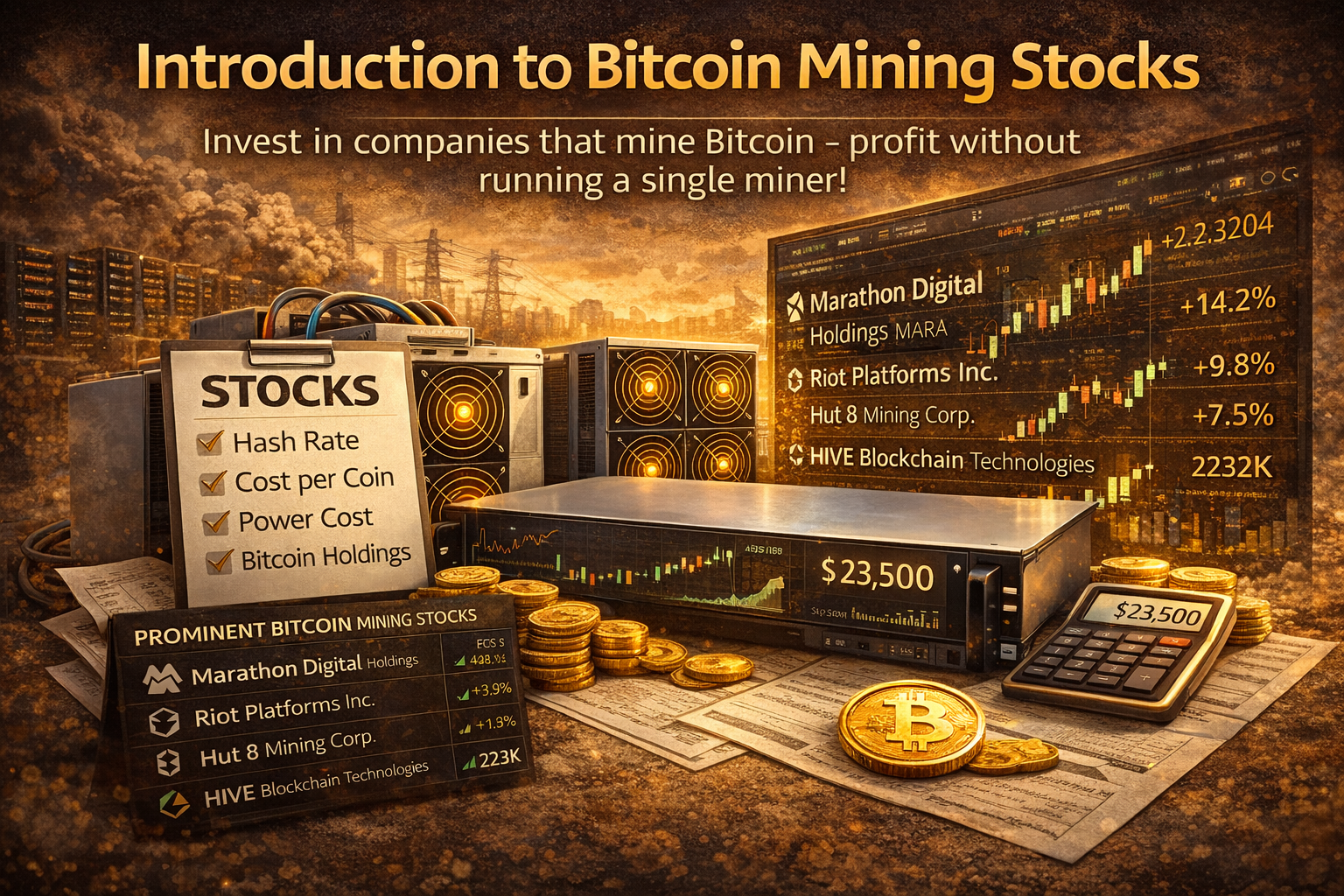
Introduction to Bitcoin Mining Stocks
What if you want exposure to mining profits without running a single miner? Bitcoin mining stocks let you invest in the companies that do the mining.
Investing in Bitcoin mining stocks means buying shares in publicly traded companies that operate large-scale mining facilities. You gain exposure to their profitability, which is tied to Bitcoin’s price and the company’s operational skill.
This is a shift from a hands-on technical role to a traditional equity investment. You’re betting on a company’s management team to execute efficiently.
The Advantage of Scale
Public mining companies operate at a level individual miners cannot match. They benefit from:
- Bargaining Power: Securing wholesale electricity contracts as low as $0.03-$0.05/kWh.
- Hardware Discounts: Purchasing ASIC miners in bulk directly from manufacturers.
- Professional Management: Dedicated teams for operations, finance, and strategic planning.
- Access to Capital: Ability to raise funds for expansion through stock or debt markets.
Evaluating a Mining Stock: Key Metrics
When analyzing a mining company, savvy investors look beyond just the Bitcoin price. Critical metrics include:
| Metric | What It Measures | Why It Matters |
|---|---|---|
| Hash Rate | Total computational power contributed. | Shows mining capacity and growth potential. |
| Production Cost per Coin | Average cost to mine one Bitcoin. | Measures operational efficiency; lower is better. |
| Power Cost | Price paid for electricity (per kWh). | The primary variable cost; dictates profit margins. |
| Bitcoin Holdings | Amount of Bitcoin on the balance sheet. | Shows treasury strength and exposure to price appreciation. |
The Leverage Effect: A Double-Edged Sword
Mining stocks often act as a leveraged play on Bitcoin’s price. Here’s why:
- In a Bull Market: If Bitcoin’s price rises 100%, a miner’s revenue may surge while its fixed costs (like power contracts) stay the same. This can lead to expanded profit margins and stock gains of 150-300% or more.
- In a Bear Market: The reverse is true. Falling Bitcoin prices squeeze margins, and fixed costs can lead to losses. Stocks often fall 1.5x to 2x more than Bitcoin’s decline.
This adds layers of risk beyond Bitcoin’s volatility, including management decisions, debt levels, and regulatory changes.
Prominent Bitcoin Mining Companies
Top publicly traded miners include Marathon Digital and Riot Platforms. These firms build and run massive mining farms. Other examples are Hut 8 and HIVE, both Canadian crypto miners. Each stock’s value moves with Bitcoin’s price and with company results.
| Company | Ticker | Focus |
|---|---|---|
| Marathon Digital Holdings | MARA | Engaged in mining cryptocurrencies |
| Riot Platforms Inc. | RIOT | Major Bitcoin mining company |
| Hut 8 Mining Corp. | HUT | Canada-based Bitcoin miner and data center operator |
| HIVE Blockchain Technologies | HIVE | Crypto miner (BTC & ETH) with data centers |
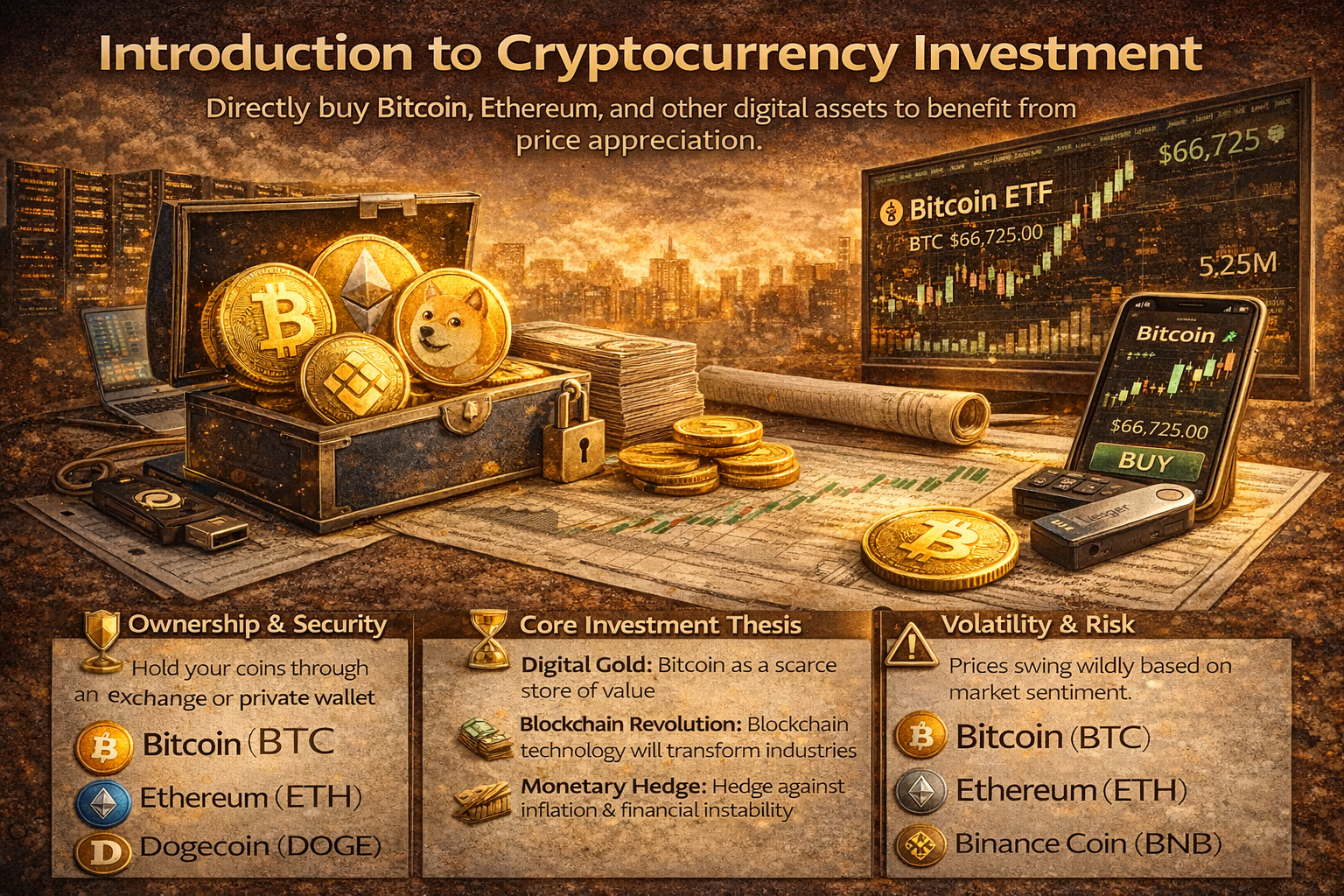
Introduction to Cryptocurrency Investment
The most straightforward path is to buy and hold the cryptocurrency itself, like Bitcoin or Ethereum. This is pure price speculation.
Direct cryptocurrency investment means purchasing and holding digital assets through an exchange or broker, with returns based solely on changes in the market price. It offers pure, unadulterated exposure to the asset’s volatility.
This approach bypasses the complexities of mining and the operational risks of companies. You are simply betting that the value of the digital asset will increase over time.
Ownership and Its Responsibilities
Choosing this path means you must understand and manage:
- Self-Custody: You can hold your coins in a private digital wallet, giving you full control but also full responsibility for security and private keys. Losing your keys means losing your assets permanently.
- Custodial Services: Many use exchanges (like Coinbase) to hold their coins. This is easier but introduces counterparty risk—if the exchange is hacked or fails, your assets could be lost.
- The Regulatory Gray Area: Direct ownership exists in a fast-evolving regulatory landscape. Tax treatment and legal status can vary significantly by country and are subject to change.
The Core Investment Thesis
Investors who buy and hold cryptocurrency directly typically believe in one or more of these long-term theses:
- Digital Gold: Bitcoin as a scarce, non-sovereign store of value.
- Technological Disruption: The underlying blockchain technology will revolutionize industries.
- Monetary Hedge: A hedge against inflation or traditional financial system instability.
This path requires a strong conviction and a high tolerance for volatility, as prices can swing dramatically based on market sentiment, news, and macroeconomic factors.
Popular Cryptocurrencies
Bitcoin (BTC) is the most well-known coin, often called “digital gold”. Other notable coins include Ethereum (ETH), which powers smart contracts, and Dogecoin (DOGE), a meme-based coin that still has broad usage. Holding these coins gives you direct participation in blockchain networks.
| Cryptocurrency | Symbol | Purpose |
|---|---|---|
| Bitcoin | BTC | Store-of-value and payment network |
| Ethereum | ETH | Platform for smart contracts and dApps |
| Dogecoin | DOGE | Community-driven coin, used for tips/payments |
| Binance Coin | BNB | Utility coin for Binance exchange discounts |
Volatility and Risk
Cryptocurrency markets never sleep. Prices can flip violently. For example, Bitcoin once fell 40% overnight in 2017 and 71% in a single crash in 2013. U.S. Bank warns crypto’s volatility far exceeds that of stocks. Only investors who can withstand these huge swings should hold crypto. In my experience, making quick trades can mean big wins or big losses.
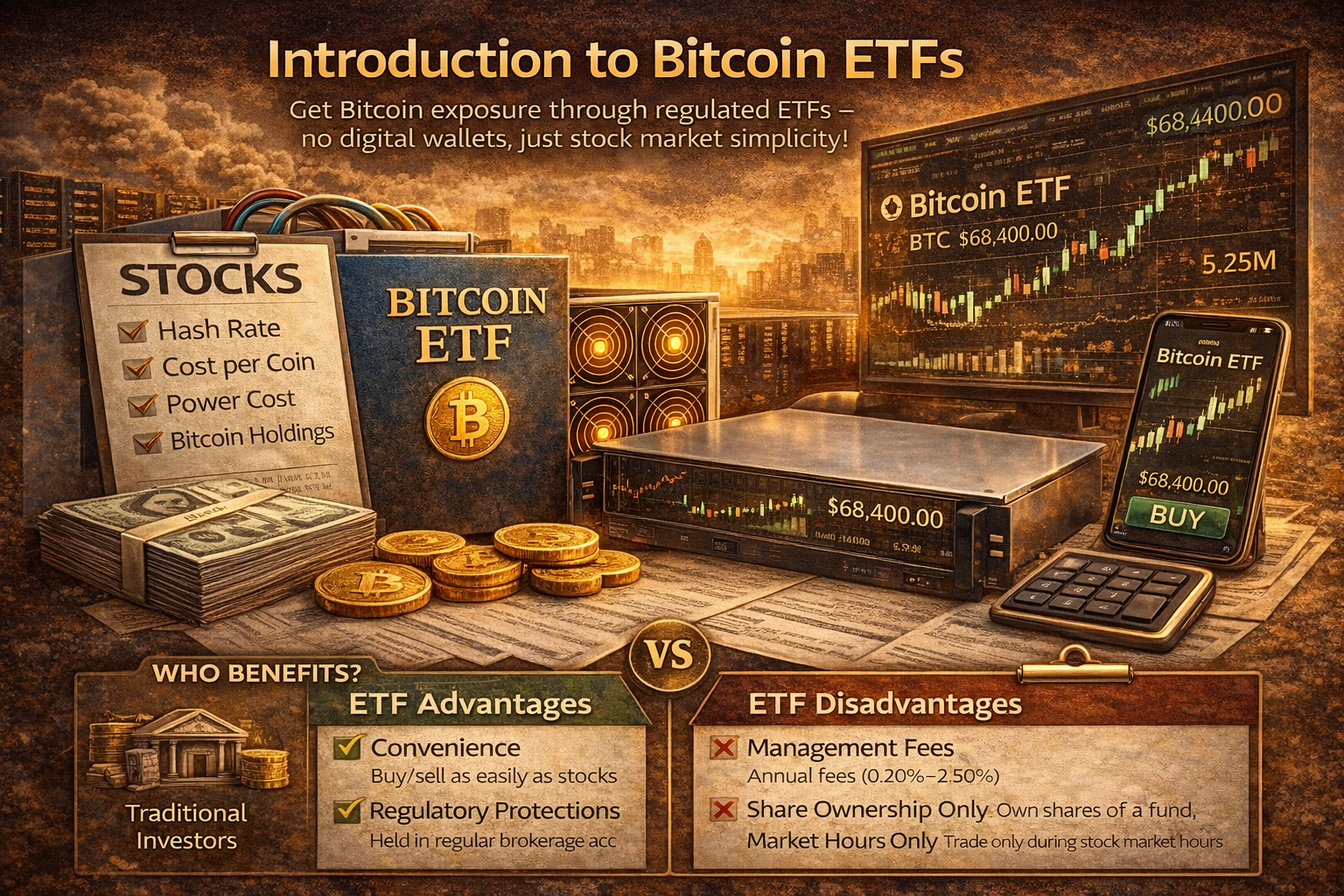
Introduction to Bitcoin ETFs
Bitcoin Exchange-Traded Funds (ETFs) are the newest and most accessible bridge between traditional finance and cryptocurrency.
A Bitcoin ETF is a regulated fund traded on traditional stock exchanges that holds actual Bitcoin. It allows investors to gain exposure to Bitcoin’s price through their regular brokerage account, without dealing with digital wallets or cryptocurrency exchanges.
The approval of spot Bitcoin ETFs in early 2024 was a watershed moment. These funds, offered by giants like BlackRock and Fidelity, directly hold Bitcoin in secure custody, and each share represents a fractional ownership of that underlying asset.
Why Choose a Bitcoin ETF? The Trade-Offs
ETFs simplify access but come with specific pros and cons.
| Advantage | Disadvantage |
|---|---|
| Convenience & Security: Buy/sell like a stock. No wallet management or exchange risk. | Management Fees: Annual fees (e.g., 0.20%-2.50%) eat into returns over time. |
| Regulatory Protections: Held in regulated brokerage accounts with associated insurance. | No Direct Ownership: You cannot use the Bitcoin for payments or transfers. You own a share of a fund, not the asset itself. |
| Tax & Retirement Account Friendly: Easily held in IRAs or 401(k)s, unlike direct crypto. | Market Hours Only: ETFs trade during stock market hours, unlike crypto markets which are 24/7. |
Who Are Bitcoin ETFs For?
Bitcoin ETFs are ideally suited for:
- Traditional Investors who want crypto exposure without leaving their familiar brokerage platform.
- Institutional Money (pension funds, endowments) that have regulatory mandates prohibiting direct cryptocurrency purchases.
- Any Investor whose priority is ease of use, security, and regulatory compliance over absolute control.
How do Crypto, Mining Stocks, and ETFs compare?
Now that we understand the three paths, let’s put them side-by-side. The right choice isn’t universal; it’s personal, based on your resources, skills, and goals.
Direct cryptocurrency investment is for the pure speculator; mining is for the hands-on technologist; mining stocks are for the leveraged equity investor; and ETFs are for the convenience-seeking traditionalist. Each offers a different risk-reward profile and level of involvement.
The following table provides a clear, at-a-glance comparison of the four core options (including direct coin purchase) across critical dimensions.
Investment Comparison Matrix
| Dimension | Direct Cryptocurrency | Direct Mining | Mining Stocks | Bitcoin ETF |
|---|---|---|---|---|
| Primary Focus | Price appreciation of the asset. | Operational profit from block rewards. | Equity growth of a mining company. | Tracking Bitcoin’s price. |
| Upfront Cost | Variable (price of coins). | Very High (hardware, setup). | Low (share price). | Low (share price). |
| Ongoing Effort | Low (monitoring). | Very High (24/7 ops, maintenance). | Medium (research companies). | Very Low (hands-off). |
| Risk Profile | High (market volatility). | Very High (op + market + tech risk). | High (market + leverage + mgmt risk). | Medium-High (market risk). |
| Potential Return | Directly matches asset price change. | Can exceed price rise if efficient. | Amplified gains/losses via leverage. | Matches price change, minus fees. |
| Liquidity | High (24/7 crypto markets). | Low (selling equipment is slow). | High (stock market hours). | High (stock market hours). |
| Best Suited For | Conviction-driven holders. | Technically skilled entrepreneurs. | Investors who can analyze equities. | Traditional or passive investors. |
Making the Choice: Which Investor Are You?
- Choose Direct Mining if: You have significant technical expertise, capital for high upfront costs, access to cheap and reliable electricity, and want a full-time, operational business. You value control and direct hardware ownership.
- Choose Mining Stocks if: You have experience analyzing public companies, understand financial leverage, and want amplified exposure to Bitcoin’s price without any operational hassle. You can tolerate higher volatility for potentially higher returns.
- Choose a Bitcoin ETF if: You want simple, secure, and regulated exposure to Bitcoin’s price. You prioritize convenience and integration with your existing traditional portfolio over direct ownership or higher potential leverage.
- Choose Direct Cryptocurrency if: You believe strongly in the asset’s long-term value, want direct ownership (for spending or self-custody), and are comfortable with the security responsibilities and pure price volatility.
Conclusion
The future of mining investments in 2026 is not a single path, but a spectrum of options tailored to different investors. Success lies in honestly assessing your own resources, risk tolerance, and desired involvement, then rigorously matching them to the realities of direct mining, mining stocks, or Bitcoin ETFs.Contact MinerSource Team Purchase Now

